

Our experts reviewed the latest {category_name } to help you compare quality, performance, durability and overall value before making your purchase.


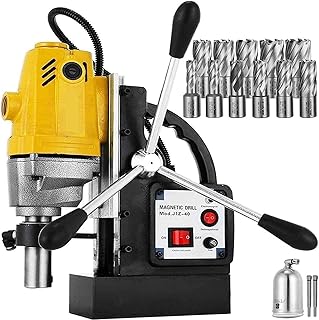


Choosing a Milwaukee drilling press is less about selecting the tool with the largest headline specification and more about matching the machine to the type of drilling you actually perform. For professional metalworking, fabrication, installation and maintenance, the important factors include drilling capacity, magnet design, speed control, tool reception, stroke length, power source, portability and the safety features available on the particular model. Milwaukee's drilling press range includes magnetic drilling machines rather than conventional workshop pillar drills. That distinction matters. A magnetic drilling press is designed to secure itself directly to suitable ferrous material, making it particularly useful when drilling structural steel, fabricated components, beams, plates and other metalwork where transporting a conventional drill press to the workpiece would be impractical. Model specifications should always be checked against the exact UK version being considered. Features, included accessories, battery configuration and electrical specifications can differ between variants and markets. A magnetic drill press and a traditional pillar drill solve different problems. A pillar drill normally sits on a workshop floor or bench and brings the workpiece to the machine. A magnetic drill press does the opposite: the machine is positioned on the workpiece and held in place by its magnetic base. This distinction is one of the most important considerations when comparing a Milwaukee drilling press with other drill press categories. A machine can have excellent specifications and still be the wrong choice if its operating format does not suit the job. Maximum broaching capacity indicates the largest diameter annular cutter the machine is designed to handle under the manufacturer's stated conditions. Milwaukee's current UK and European magnetic press range includes models with capacities around 38mm and 41mm, depending on the model. Do not interpret maximum broaching diameter as a guarantee that every material, cutter and drilling situation will produce identical results. Material thickness, cutter quality, cutting fluid, feed pressure and operating technique all affect practical performance. Solid-drill capacity is a different specification from annular-cutter capacity. Milwaukee lists a maximum straight-shank twist-drill capacity of 13mm for its current M18 FMDP and MDP 41 magnetic presses, while the MDE 41 also lists 13mm. This is useful when comparing machines because a larger annular-cutter rating does not mean the machine is intended to replace a general-purpose drill driver for every drilling operation. Stroke length describes how far the spindle or cutting system can travel. Milwaukee lists a 146mm stroke length for the M18 FMDP, MDP 41 and MDE 41. A generous stroke can make it easier to accommodate different accessories and material configurations, but it should be assessed alongside the actual cutter length and the thickness of the workpiece. Magnetic holding force is an important specification for magnetic drilling because the machine relies on the base remaining securely attached to suitable ferrous material. The M18 FMDP and MDP 41 use a self-powered permanent magnet rated by Milwaukee at 8,890N of holding force, while the MDE 41 uses an electro-powered magnet rated at 9,930N. Holding-force figures should not be treated as a substitute for safe setup. The condition, thickness, flatness and cleanliness of the steel, as well as the drilling position and the forces generated during cutting, all matter. The manufacturer's safety instructions should be followed for the particular application. Motor power and spindle speed need to be considered together. Higher power is useful for demanding drilling, but cutting performance also depends on selecting an appropriate speed for the cutter and material. The MDE 41 is specified with a 1,200W motor and a two-speed gearbox offering 475rpm and 730rpm. The M18 FMDP uses two speeds of 400rpm and 690rpm. For buyers, this means a simple comparison of wattage can be misleading. A machine with useful speed ranges, appropriate cutter compatibility and effective overload management may be more suitable than a model selected solely because its motor specification looks larger on paper. The M18 FMDP and MDP 41 use self-powered permanent magnets. Milwaukee states that the permanent magnet design prevents accidental magnet deactivation and provides a holding force of 8,890N. A permanent-magnet system can be particularly attractive for users who value the operational characteristics of a magnet that does not depend on continuous electrical energisation in the same way as an electro-powered system. Nevertheless, safe operation still depends on correct positioning, adequate contact with the workpiece and compliance with the manufacturer's instructions. The MDE 41 uses an electro-powered magnet and is specified with 9,930N of holding force. It is a 1,200W mains-powered machine with a two-speed gearbox. An electro-magnet can be an appropriate choice where mains power is readily available and the operating environment suits a corded machine. The trade-off is that the user needs to consider cable management and the electrical supply as part of the overall setup. These models should not be treated as interchangeable simply because they occupy the same general category. The most meaningful difference for many buyers is therefore not simply capacity. The choice involves cordless versus mains operation and permanent versus electro-powered magnetic retention, alongside the particular requirements of the work environment. The M18 FMDP is designed around Milwaukee's M18 battery platform. The UK version is listed as the M18 FMDP-502C, model number 4933451013. Milwaukee specifies the kit with M18 5.0Ah batteries, an M12-18 FC fast charger and a kitbox. The machine combines a POWERSTATE brushless motor, REDLITHIUM battery technology and REDLINK PLUS electronic intelligence. Milwaukee also specifies AUTOSTOP lift-off detection, a permanent magnet, a two-speed gearbox and an integrated lubrication system. For existing M18 users, platform compatibility can therefore be an important part of the buying decision. A buyer who already owns suitable M18 batteries may assess the cordless machine differently from someone starting a battery platform from scratch. One of the most important technical distinctions when buying a magnetic drilling press is the difference between annular cutters and conventional twist drill bits. When comparing prices and specifications, check whether the package contains the accessories you actually require. A low headline price can become less attractive if the necessary cutters, adaptors, lubrication equipment or other accessories have to be purchased separately. Milwaukee specifies AUTOSTOP lift-off detection on the M18 FMDP, MDP 41 and MDE 41. The system is intended to detect excessive rotation and automatically stop the tool to improve user protection. Milwaukee describes AUTOSTOP as shutting the tool down after 45 degrees of sharp movement in bind-up situations. This is a useful safety feature, but electronic protection should never be considered a replacement for correct machine positioning, a suitable safety strap, appropriate workholding and proper operating technique. Milwaukee lists a safety strap among the standard equipment for the M18 FMDP, MDP 41 and MDE 41. When working on elevated, vertical or otherwise awkward steelwork, the safety strap should be treated as part of the setup rather than an optional accessory. Follow the manufacturer's instructions for correct attachment and use. Magnetic drilling depends on secure contact between the magnetic base and the workpiece. Paint, scale, dirt, swarf, coatings, uneven surfaces and insufficient material thickness can affect the suitability of the setup. Cleaning the contact area before positioning the machine is therefore an important practical step. Lubrication is not simply a convenience when drilling metal. Appropriate cutting fluid can help manage heat, reduce friction and support cutter life when used correctly. The M18 FMDP includes a lubrication tank with hose and a magnetic lubrication tank holder, while Milwaukee lists a spray can as standard equipment for the MDP 41 and MDE 41. Buyers should consider how lubrication will be handled in the actual workplace. A vertical drilling position, for example, may require a different approach from drilling horizontally on a clean workshop floor. Milwaukee specifically describes the M18 FMDP's on-board lubrication arrangement as useful for vertical drilling positions. A cordless model such as the M18 FMDP can make sense where portability and freedom from a mains cable are priorities. This is particularly relevant for installation, maintenance and structural work where the machine has to be carried to the steel rather than used in a fixed workshop. A mains-powered MDP 41 or MDE 41 may be preferable where a suitable electrical supply is always available. Both offer a 41mm maximum annular drilling capacity and two-speed operation, giving them a useful specification profile for demanding steel-drilling work. The M18 FMDP becomes particularly relevant when battery-platform compatibility is already part of the tool ecosystem. Milwaukee states that the machine works with all M18 batteries, although the supplied kit configuration should be checked carefully before purchase. If large holes are a routine requirement, compare annular-cutter capacity first rather than relying on general drill specifications. The difference between a 38mm and 41mm maximum broaching capacity may matter when the job regularly approaches the upper end of the required hole diameter. Weight deserves more attention than it often receives in product comparisons. A magnetic drilling press may be considerably more substantial than an ordinary handheld drill because the machine has to generate cutting force while maintaining secure contact with the workpiece. The M18 FMDP, for example, is specified in Milwaukee's UK catalogue at 13.0kg with an M18 B5 battery pack. When comparing machines, consider not just the quoted weight but also how the tool will be transported, lifted into position and aligned. A machine that is technically capable of a task may still be impractical if operators need to reposition it frequently in difficult locations. A two-speed gearbox allows the machine to operate at different rotational speeds according to the drilling application. Milwaukee specifies 400rpm and 690rpm for the M18 FMDP, while the MDP 41 and MDE 41 are specified at 475rpm and 730rpm. This matters because cutting conditions are not identical across every diameter and accessory. Rather than treating the highest rpm as automatically preferable, buyers should consider the recommended operating conditions for the cutter and material being used. For professional equipment, purchase price is only one part of value. Consider how often the machine will be used, how demanding the applications are, whether replacement accessories are readily obtainable, whether the battery platform fits existing equipment and whether the machine's configuration is appropriate for the working environment. It is also worth distinguishing between manufacturer claims and independent customer feedback. Manufacturer specifications are the best starting point for technical capabilities, while verified customer reviews can provide additional insight into ownership considerations. Reviews should be assessed for relevance to the same model and application rather than treated as interchangeable evidence across an entire product family. The best-value machine is not necessarily the cheapest model. A more useful comparison considers the cost and capability of the complete setup against the work it is expected to perform. For a cordless buyer, include the value of batteries and a charger when comparing a complete kit with a bare-tool package. For a mains-powered buyer, consider whether the absence of batteries is an advantage because the machine will remain in a workshop or fabrication environment. Capacity should also be matched to actual requirements. If most holes are well below the machine's maximum diameter, paying substantially more for capacity that is rarely used may not represent good value. Conversely, regularly working at the upper limit of a smaller machine can make a higher-capacity model the more sensible long-term purchase. A Milwaukee magnetic drilling press is most relevant to users who regularly drill steel or other suitable ferrous workpieces and need a machine that can be positioned directly at the work area. Fabricators, installers, maintenance professionals, welders and tradespeople working with structural steel may find the format more useful than a conventional bench-mounted drilling machine. For occasional domestic drilling in timber, masonry or small metal components, a magnetic drilling press is generally a specialised solution rather than a universal replacement for a conventional drill driver or hammer drill. Buyers should select the tool category according to the material, hole sizes and working environment involved. Specialist machinery is not automatically the best choice for every drilling job. If your typical work involves small holes, lightweight materials or portable general-purpose drilling, a conventional drill driver or rotary drill may be more practical. Likewise, if all drilling takes place on small workpieces in a workshop, a conventional pillar drill may provide a more appropriate format. The strongest buying decision begins with the application and works backwards to the machine rather than starting with the brand or the highest specification. Regular care can help maintain reliable operation, particularly in environments where metal swarf, cutting fluid and dust are unavoidable. Manufacturer specifications and customer reviews answer different questions. Specifications establish measurable characteristics such as drilling capacity, speed, stroke and magnetic holding force. Customer feedback can help prospective buyers understand practical ownership issues, but individual experiences vary according to application, operator technique and expectations. When reading reviews, look for comments that identify the exact model and describe the type of drilling being performed. A review based on occasional workshop use may have limited relevance to someone using the machine every day on structural steel. It is also sensible to distinguish between a review of the tool itself and a review of a particular retailer, kit configuration or delivery experience. Those are separate considerations when evaluating the underlying machine. There is no single best model for every buyer. The appropriate choice depends on the required drilling capacity, power source, working environment, cutter requirements and whether cordless operation is important. The M18 FMDP, MDP 41 and MDE 41 each use different configurations that suit different priorities. Yes. The M18 FMDP is a cordless magnetic drilling press built around Milwaukee's M18 battery system. The UK M18 FMDP-502C kit is specified with M18 5.0Ah batteries and an M12-18 FC charger. Milwaukee specifies a maximum annular drilling capacity of 38mm and a maximum straight-shank twist-drill capacity of 13mm for the M18 FMDP. Both are mains-powered magnetic drilling presses with a stated 41mm maximum annular drilling capacity, 13mm straight-shank drilling capacity, two-speed operation and 146mm stroke. The key distinction is the magnetic system: the MDP 41 uses a self-powered permanent magnet, while the MDE 41 uses an electro-powered magnet. Yes. Milwaukee's magnetic drilling press range is specifically designed around drilling applications in steel and other suitable ferrous materials. The current range includes cordless and mains-powered configurations. Yes, the current M18 FMDP, MDP 41 and MDE 41 specifications include maximum capacities for straight-shank twist drill bits. Milwaukee lists 13mm for these models and supplies a 13mm chuck with Weldon adaptor in the stated standard equipment. A 19mm Weldon reception refers to the interface used to mount compatible cutters or accessories. It is important because buyers need to ensure that their chosen annular cutters and other accessories are compatible with the machine's reception system. It can be, particularly when the ability to work without a mains cable is valuable. The benefit is most apparent on mobile jobs where access to electrical outlets is inconvenient or where cable management would make positioning the machine more difficult. If the machine will remain in a workshop with reliable mains power, a corded model may be the more straightforward option. It is an important specification, but it should never be assessed in isolation. Milwaukee specifies 8,890N for the permanent magnets in the M18 FMDP and MDP 41 and 9,930N for the electro-powered magnet in the MDE 41. Actual suitability also depends on the workpiece and setup conditions. Check the manufacturer's instructions for the specific machine, ensure the magnetic contact area and workpiece are suitable, use the specified safety equipment and establish a secure setup before drilling. Vertical and elevated applications deserve particular attention because gravity and the consequences of tool movement add to the risks associated with incorrect positioning. A useful independent buying guide should separate manufacturer specifications from editorial judgement and should not assume that the most expensive or highest-capacity machine is automatically the right choice. The strongest comparison considers the application first, then evaluates capacity, power source, cutter compatibility, safety, handling and total ownership requirements. Specifications quoted in this guide are based on Milwaukee's published product information for the relevant models. Because manufacturers can update product configurations, buyers should verify the current UK specification, included accessories and retailer listing before placing an order. Customer ratings and retailer availability can also change over time and should be checked at the point of purchase. The best Milwaukee drilling press is the one that fits the job rather than simply the one with the largest specification. For mobile steel drilling, the cordless M18 FMDP offers a distinctive combination of M18 battery compatibility, permanent magnetic retention and a 38mm annular drilling capacity. For mains-powered applications requiring 41mm annular capacity, the MDP 41 and MDE 41 provide closely related drilling specifications while differing in their magnetic systems. Before buying, compare the exact model number, power configuration, drilling capacity, cutter reception, included equipment, safety features and weight. Most importantly, make sure the machine is designed for the materials and working conditions in which it will actually be used. That approach provides a more reliable basis for comparing products than price, star ratings or headline specifications alone.Milwaukee Drilling Press Buying Guide: What to Compare Before You Buy
Milwaukee Magnetic Drill Press vs a Conventional Pillar Drill
Key Milwaukee Drilling Press Specifications Explained
Maximum Broaching Capacity
Maximum Drilling Capacity with a Solid Bit
Stroke Length
Magnetic Holding Force
Motor Power and Speed
Permanent Magnet vs Electromagnetic Milwaukee Drilling Press
Permanent-Magnet Models
Electro-Magnet Models
Milwaukee M18 FMDP vs MDP 41 vs MDE 41
Why the M18 FMDP Is Different
Annular Cutters vs Twist Drill Bits
Safety Features Worth Comparing
AUTOSTOP Lift-Off Detection
Safety Strap
Workpiece Condition
Lubrication and Cutting Performance
How to Choose the Right Milwaukee Drilling Press for Your Work
For Mobile Fabrication and Site Work
For Workshop-Based Steel Drilling
For Users Already Invested in M18 Batteries
For Larger-Diameter Steel Holes
Common Buying Mistakes to Avoid
Weight, Portability and Ergonomics
Two-Speed Gearboxes: Why They Matter
Build Quality and Long-Term Ownership Considerations
What to Check Before Ordering a Milwaukee Drilling Press in the UK
How to Compare Milwaukee Drilling Presses on Value
Milwaukee Drilling Press Features That Matter Most
Who Should Buy a Milwaukee Magnetic Drilling Press?
When a Milwaukee Magnetic Drill Press May Be Overkill
Maintenance and Care Considerations
Understanding Manufacturer Specifications vs Customer Reviews
Frequently Asked Questions About Milwaukee Drilling Presses
What is the best Milwaukee drilling press?
Is the Milwaukee M18 FMDP cordless?
What is the maximum drilling capacity of the M18 FMDP?
What is the difference between MDP 41 and MDE 41?
Does Milwaukee make magnetic drill presses for steel?
Can a Milwaukee magnetic drilling press use twist drill bits?
What does 19mm Weldon mean?
Is a cordless magnetic drilling press worth choosing?
How important is magnetic holding force?
What should I check before using a magnetic drill press vertically?
Final Buying Checklist
Our Approach to Comparing Milwaukee Drilling Presses
Bottom Line: Choosing the Right Milwaukee Drilling Press