

Our experts reviewed the latest {category_name } to help you compare quality, performance, durability and overall value before making your purchase.


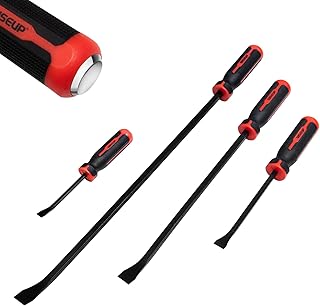


Choosing the right pry bar is less about finding the heaviest tool and more about matching the bar's length, profile, tip design, steel construction and intended application to the job. A compact flat pry bar can be far more useful for trim, flooring and cabinet work, while a longer wrecking bar is better suited to demanding demolition and heavy levering. For buyers comparing pry bars in the UK, the most useful distinction is between precision pry bars, flat bars, moulding bars, claw bars and full-size wrecking bars. These tools overlap in purpose, but their geometry can make a substantial difference to control, leverage, access and the amount of damage caused to the material being removed. Established tool manufacturers such as STANLEY, Bahco, Faithfull, Roughneck and Draper offer different approaches to bar design, so specifications should be compared rather than choosing solely by brand name or appearance. A pry bar is a manually operated levering tool designed to apply controlled mechanical advantage. Depending on its shape, it can be used for separating materials, lifting components, removing nails, dismantling timber, pulling boards, opening joints and carrying out general renovation or demolition work. The basic principle is straightforward: the bar provides a longer lever arm than your hand could normally achieve, allowing relatively modest force to produce considerably greater movement at the working end. Typical applications include: A pry bar should not automatically be treated as a substitute for every other hand tool. Using a screwdriver as a lever, for example, can damage the screwdriver and create unnecessary risk. Conversely, using a large wrecking bar for delicate trim can destroy the material you are attempting to save. Flat pry bars have a relatively thin, broad working end. Their geometry makes them useful when access beneath a component matters more than maximum demolition force. They are particularly useful for trim, flooring, light dismantling and jobs where the working end needs to slide into a narrow gap. A broad contact surface can also distribute force more effectively than a narrow point, which may help reduce localised damage when the tool is positioned correctly. Bahco, for example, offers flat-head pry bars in several lengths, including compact 200 mm and 300 mm versions as well as longer 450 mm and 600 mm models. Its published specifications show that dimensions and weight increase with length, illustrating why size should be selected according to the work rather than simply choosing the longest available tool. Moulding bars are designed with finer, often more carefully shaped ends for pulling nails and lifting trim. They are a better choice than a large wrecking bar when preserving skirting boards, mouldings or other finish materials is important. STANLEY's moulding-bar range, for example, includes compact steel designs with contoured profiles and polished, bevelled claws intended for precision nail pulling and prying. A claw bar incorporates a curved or forked nail-pulling end. This makes it useful when the job involves extracting nails as well as levering material apart. The shape of the claw matters. A narrow claw can reach smaller or more recessed nails, while a broader claw may provide greater support when pulling larger fixings. The bevel and finish around the claw can also influence how easily it gets underneath a nail head. Wrecking bars are intended for heavier work and generally provide more leverage than compact pry bars. They commonly combine a flat or angled end with a curved claw, giving the user two different working configurations. STANLEY's FATMAX wrecking bars, for example, are available in different lengths, including 24-inch, 36-inch and 42-inch models. The manufacturer specifies spring-steel construction on these models, with bevelled claws, a second tip and a flat striking face on the relevant designs. Longer bars can produce greater leverage, but that does not automatically make them better. A long bar requires more clearance, can be cumbersome in confined areas and may apply excessive force to delicate materials. For substantial demolition, the construction of the shaft and working ends becomes particularly important. Larger professional-style wrecking bars can be substantially heavier than compact pry bars. Bahco's WBB wrecking-bar range, for example, includes C45E steel designs with bent and flat ends, heat treatment around the nail-pulling areas and lengths ranging from compact versions to much longer bars. Its premium WBP range uses SCM440 steel and offers multiple lengths and profiles. The existence of these different specifications demonstrates an important buying principle: length, steel grade, heat treatment, cross-sectional shape and end geometry all matter independently. Length is one of the most important specifications to compare. In simple terms, increasing the distance between the user's hands and the fulcrum can increase leverage. However, real-world performance also depends on where the bar contacts the material, the geometry of the working end and how much clearance is available. These ranges are practical categories rather than rigid rules. A 450 mm bar is not inherently suitable for every medium-duty application, just as a 1,000 mm bar is not necessarily the best option for heavy work in every situation. No. Length is only one part of the equation. A longer handle can increase leverage when the geometry of the job permits it, but the usable leverage is affected by the fulcrum position, working-end shape, angle of application and resistance of the material. A long bar can also become less practical if it cannot be positioned securely. If the working end cannot obtain a good purchase, additional length may simply make the tool harder to control. For this reason, compare length and working-end geometry together rather than treating the longest specification as the strongest or best choice. Steel is the dominant material for conventional pry and wrecking bars because it offers the combination of strength, stiffness and durability required for levering applications. Different manufacturers use different steel grades and treatments. STANLEY specifies spring steel on several of its FATMAX wrecking bars, while Bahco lists high-performance alloy steel for some of its flat pry bars and C45E or SCM440 steel for particular wrecking-bar ranges. These specifications should not be treated as interchangeable marketing labels. A steel grade tells you something about the material, but the finished tool also depends on its cross-section, heat treatment, manufacturing process and working-end design. Heat treatment can alter the hardness and mechanical properties of steel. Pry bars need an appropriate balance: excessive hardness can make a component less tolerant of impact or bending, while insufficient hardness can reduce resistance to deformation or wear at the working end. Bahco's published specifications illustrate this distinction by giving different hardness ranges for the shaft and nail areas on some wrecking bars. Its premium WBP range also specifies a uniform hardness range across the bar. When comparing products, look for specific manufacturer information about steel and treatment rather than relying on vague descriptions such as "industrial strength" or "professional quality". Specialist non-sparking bars are available for applications where conventional steel tools may create an unacceptable ignition risk. Bahco, for example, lists aluminium-bronze wrecking bars specifically designed as non-sparking tools for potentially explosive environments. These are specialist tools and should not be selected simply because the material sounds safer or more advanced. The manufacturer's stated application, restrictions, certification information and site-specific safety requirements should be checked before use. A flat end is useful when the objective is to get underneath a board or component and distribute force across a relatively broad contact area. The thickness and width of the tip affect access. A thinner edge may enter a tighter gap, whereas a broader working surface may provide better support once positioned. A bevel can make it easier to introduce the working end into a gap. Precision grinding is another specification worth checking, particularly on bars intended for controlled penetration. STANLEY specifies precision-ground edges on several of its FATMAX wrecking bars, while its moulding bars use polished and bevelled claws for nail pulling and prying. A curved end changes the geometry of the lever and can provide useful purchase when lifting or pulling. It is especially common on wrecking bars and nail-pulling tools. A forked claw is useful for positioning around a nail shank or head. A slotted design can make nail extraction more practical than a simple flat tip. When comparing claws, examine the opening, thickness, angle and finish rather than simply looking for the word "claw" in a specification. Some wrecking bars incorporate a flat striking face intended to receive hammer blows. This is a useful feature when controlled impact is part of the intended application, but buyers should check the manufacturer's instructions before striking any particular bar. A pry bar without a purpose-designed striking area should not automatically be assumed to be suitable for repeated hammering. Not all pry bars have handles. Traditional wrecking bars are often bare steel, whereas compact pry bars may incorporate PVC, polypropylene or thermoplastic rubber components. Handle design can affect comfort, control and grip, especially during repetitive work. Bahco, for example, specifies polypropylene and thermoplastic rubber on some of its hammerable flat-head pry bars and PVC handles on other flat pry-bar models. A comfortable handle is useful, but it should not distract from the structural requirements of the tool. For demanding leverage work, shaft construction and working-end geometry remain fundamental. Weight is often misunderstood when comparing pry bars. A heavier bar may be associated with a more substantial construction, but additional mass also makes the tool harder to carry, position and control. For overhead, awkward or repetitive work, unnecessary weight can quickly become inconvenient. Published manufacturer specifications demonstrate considerable variation. Bahco's compact 200 mm flat pry bar is listed at 75 g, while longer flat bars and larger wrecking bars weigh considerably more. STANLEY lists its 36-inch FATMAX wrecking bar at approximately 2 kg and its 42-inch model at approximately 3 kg. The best choice therefore depends on the balance between required leverage, physical access, transport and control. Choose a relatively compact flat or moulding bar with a suitable claw and a working end that can be introduced behind the trim. A smaller tool gives better control and is easier to position around corners. Protecting the wall and trim may also require a suitable spreader or sacrificial block between the bar and the finished surface. A flat pry bar can be particularly useful because the working end needs to enter a narrow joint. If the boards are heavily fixed, a longer bar may provide useful additional leverage. Consider the board material and whether you intend to reuse it. The tool that removes a board fastest is not necessarily the tool that leaves it in the best condition. Look for a properly formed claw, preferably with a profile designed to get underneath the nail head. A precision claw bar can be preferable to a large demolition bar where controlled extraction matters. A substantial wrecking bar is generally more appropriate than a small trim bar when the task involves repeated heavy levering. Compare shaft material, length, working-end thickness, claw design and whether a striking face is provided. A medium-length flat or combination pry bar can offer a useful compromise. If your work covers both delicate trim and heavier dismantling, owning two differently sized tools can be more practical than trying to make one bar perform every task. A single bar is sufficient if your work is predictable. A set becomes more useful when you regularly switch between precision jobs and heavier dismantling. A practical combination might include: There is little benefit in buying several bars that are almost identical in length and geometry. A small selection covering different applications usually provides more useful capability. When comparing several products side by side, prioritise specifications in the following order. Longer does not automatically mean better. A long bar can be awkward in confined rooms, difficult to transport and unnecessarily aggressive for delicate work. A tool may have the right overall length but still be unsuitable because its working end cannot fit into the gap you need to access. Weight can provide useful context, but it is not a substitute for published construction details and application information. Large wrecking bars can exert substantial force. When working with finished timber, painted surfaces or reusable materials, a more controlled tool is often the better choice. The bar does not operate in isolation. The surface against which it pivots can determine both effectiveness and the likelihood of damage. A suitable protective block can sometimes make a major difference to the result. Only bars designed for impact should be treated as suitable for hammering. Check the manufacturer's specifications for a striking face or through-blade construction before using impact. The terms are sometimes used interchangeably in online listings, but product geometry varies substantially. A compact precision pry bar and a metre-long wrecking bar are not equivalent tools simply because both can be described as pry bars. Pry bars can store and release considerable mechanical force. The most important safety consideration is maintaining control of the bar and understanding what may move when force is applied. Good maintenance is simple because most pry bars have few moving parts. Remove dirt, adhesive, paint and other residue after use. Build-up around the tip or claw can make accurate positioning more difficult. Inspect the bar for permanent bends, mushrooming, cracks or damaged claws. A pry bar is subjected to high mechanical loads, so visible deformation should not be dismissed as cosmetic. Keep conventional steel tools dry and address surface rust before it becomes extensive. Store them somewhere reasonably dry rather than leaving them exposed to moisture. Grinding or aggressively reshaping a pry bar can alter the geometry and potentially affect the material properties of a heat-treated tool. If the working end becomes unsuitable, replacement is generally preferable to improvised modification. Online photographs can make different bars look remarkably similar, so specifications deserve close attention. Start by checking whether the manufacturer identifies the steel or construction material. Then look for precise dimensions, weight, working-end design and intended application. Where heat treatment or hardness information is published, this can provide additional useful context. Also distinguish between a manufacturer's specification and retailer-generated marketing copy. The manufacturer is normally the more appropriate source for technical details, while independent customer reviews can help identify recurring practical issues. Customer ratings can be useful, but a high average rating does not tell you whether a particular bar is suitable for your job. When reading verified customer reviews, look for comments about the exact characteristics that matter to your application: Be cautious with reviews that judge a product against an application for which the manufacturer never intended it. A compact trim bar should not necessarily be criticised for failing to perform like a heavy demolition bar. STANLEY has a broad range covering compact moulding bars, claw bars, flat bars and larger wrecking bars. Its published UK specifications make it possible to compare dimensions, shaft material, finish, claw design and weight across several models. Bahco offers an unusually broad selection of pry and wrecking-bar formats, including flat pry bars, hammerable through-blade designs, conventional wrecking bars, premium wrecking bars and specialist non-sparking models. Faithfull is another established name worth considering when comparing general-purpose hand tools. Buyers should assess the specification of the individual model rather than assuming all products within a brand have identical construction. Roughneck is associated with heavy-duty tools and demolition equipment. When comparing its pry and wrecking bars with alternatives, pay particular attention to bar length, profile, end configuration and weight. Draper offers a broad selection of workshop and DIY tools. As with any brand, compare the exact model specification and intended use rather than selecting purely on brand recognition. The difference between a professional and DIY purchase is not always about whether one tool is inherently stronger. Professional users may benefit from a wider selection of sizes because the right tool can save time across many different jobs. They may also place greater value on consistency of dimensions, specialist configurations and availability of replacement tools. A DIY user who only occasionally removes flooring or dismantles furniture may have different priorities. A compact, versatile bar can be preferable if it is easier to store and covers the majority of intended applications. The most sensible approach is to define the work first and then select the specification. For many household and renovation tasks, a compact or medium-length pry bar is easier to control than a very long wrecking bar. For major demolition, greater length may be worthwhile where sufficient clearance is available. If you are uncertain, consider three questions: Answering those questions usually narrows the choice more effectively than starting with a brand or price. There is no single best pry bar for every application. The best option depends on the required leverage, working space, tip geometry, material, weight and whether the job involves delicate prying, nail extraction or heavy demolition. A pry bar is a broad term for a levering tool, while a wrecking bar generally refers to a larger, heavier design intended for demanding dismantling and demolition. The terminology varies between manufacturers and retailers, so the physical specifications are more useful than the product name alone. The appropriate length depends on the job. Short bars provide better access and control, medium bars offer a useful balance of leverage and manoeuvrability, and long bars are useful when substantial leverage is required and adequate clearance exists. Not necessarily. Length primarily changes leverage and reach. Strength depends on factors including material, cross-sectional geometry, heat treatment and construction. A longer bar can also be less suitable for confined or precision work. There is no single steel grade that should be declared universally best. The finished tool depends on steel composition, heat treatment, geometry and manufacturing quality. Published specifications from manufacturers are more useful than generic claims about steel strength. A handled design can improve grip and comfort for suitable applications, particularly on compact pry bars. For heavy-duty wrecking bars, traditional bare-steel construction is common. Choose according to the work rather than treating a handle as a universal indicator of quality. Only if the manufacturer specifically designs the product for that purpose. A pry bar should not automatically be treated as a general-purpose chisel simply because it has a pointed or bevelled end. Only use hammer impact where the tool has a manufacturer-designated striking surface or through-blade construction intended for that purpose. Do not assume that every steel pry bar is designed to withstand repeated impact. Many are. Models with appropriately shaped claws or nail slots are particularly suited to nail extraction. For delicate trim, a smaller precision claw or moulding bar is usually more appropriate than a large demolition bar. Use the smallest suitable tool, position the working end securely, distribute pressure where practical and protect finished surfaces with an appropriate block or barrier. Work progressively rather than applying maximum force immediately. Look for cracks, severe permanent bending, damaged claws, mushroomed striking areas or other significant deformation. If a tool has suffered abnormal loading or shows structural damage, it should not simply be returned to service without proper assessment. No. Price should be considered alongside construction, dimensions, application and manufacturer specifications. A premium heavy-duty bar may be unnecessary for occasional trim work, while an inexpensive compact tool may be inappropriate for demanding demolition. The strongest buying decision comes from matching the pry bar to the job rather than searching for a universal "best" model. Start with the task, decide how much leverage is required, assess the available clearance and then compare length, working-end geometry, steel construction, weight and handle design. For precision work, prioritise access and control. For nail removal, examine the claw carefully. For general renovation, a medium-length flat or combination bar can offer useful versatility. For heavy demolition, concentrate on robust construction, suitable length and purpose-designed working ends. When comparing current UK options, check the exact model number and manufacturer specification, then compare verified customer feedback and current retailer information. Product ranges, specifications, prices and availability can change, so the details should be confirmed at the point of purchase. A well-chosen pry bar is a simple tool, but the right combination of geometry, material and size can make difficult dismantling work considerably more controlled and efficient.Best Pry Bars in the UK: Buying Guide, Features, Specifications and Comparison
What Is a Pry Bar Used For?
Types of Pry Bar Compared
Flat Pry Bars
Moulding Bars
Claw Bars
Wrecking Bars
Heavy-Duty Wrecking Bars
How Pry Bar Length Affects Performance
Does a Longer Pry Bar Always Give More Leverage?
Steel and Material Choices
High-Carbon and Alloy Steel
Heat Treatment
Non-Sparking Pry and Wrecking Bars
Working-End Design: What Should You Compare?
Flat Ends
Bevelled Edges
Curved Ends
Forked or Slotted Claws
Striking Faces
Handle Design and Grip
Weight: When Heavier Is Not Better
How to Choose the Right Pry Bar for Different Jobs
For Removing Skirting Boards
For Removing Floorboards
For Nail Removal
For Demolition
For General DIY
One Pry Bar or a Set?
Pry Bar Comparison: Which Specifications Matter Most?
Common Pry Bar Buying Mistakes
Buying the Longest Bar Available
Ignoring the Tip Thickness
Choosing by Weight Alone
Using a Demolition Bar for Delicate Work
Ignoring the Fulcrum
Assuming Every Pry Bar Is Hammerable
Confusing Pry Bars With Wrecking Bars
Safety and Correct Use
How to Maintain a Pry Bar
Clean the Working Ends
Check for Deformation
Protect Against Corrosion
Do Not Modify the Working End
How to Assess Pry Bar Quality Before Buying
How to Compare Customer Reviews Properly
Brand Comparison: What to Look For
STANLEY
Bahco
Faithfull
Roughneck
Draper
Professional Versus DIY Pry Bars
What Size Pry Bar Should You Buy?
Pry Bar Buying Checklist
Frequently Asked Questions About Pry Bars
What is the best pry bar?
What is the difference between a pry bar and a wrecking bar?
What is the best length for a pry bar?
Are longer pry bars stronger?
What steel is best for a pry bar?
Should I buy a pry bar with a handle?
Can a pry bar be used as a chisel?
Can you hammer a pry bar?
Are pry bars suitable for removing nails?
How do I prevent damage when using a pry bar?
How do I know if a pry bar is damaged?
Is an expensive pry bar always better?
Final Buying Advice