

Our experts reviewed the latest {category_name } to help you compare quality, performance, durability and overall value before making your purchase.


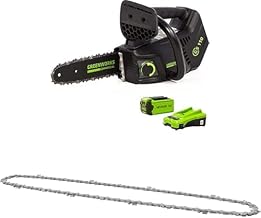


Choosing a Greenworks cordless chainsaw is less about finding the chainsaw with the biggest guide bar or highest voltage and more about matching the machine to the type of cutting you actually expect to do. Greenworks offers several battery platforms and chainsaw formats, including compact 24V machines, standard 40V chainsaws, a dual-battery model, and specialist pole-saw options. That means two chainsaws carrying the Greenworks name can have substantially different weight, chain speed, battery requirements and intended uses. For UK buyers, the most useful comparison points are guide-bar length, chain speed, motor type, battery platform, supplied battery capacity, machine weight, chain lubrication, chain-tensioning system and the amount of cutting you expect to complete in a typical session. The exact model number and kit contents should always be checked before purchase because a tool-only version and a battery kit can look very similar while offering quite different overall value. The guide bar is one of the easiest specifications to understand, but it should not be treated as a simple measure of cutting performance. A longer bar can provide greater cutting capacity, whereas a shorter bar can make a compact chainsaw easier to manoeuvre for pruning and smaller garden work. Greenworks' UK range includes compact mini chainsaws around 10cm, handheld models from approximately 25cm to 40cm, and other specialist cutting tools. The manufacturer's current chainsaw collection therefore covers considerably more than one type of job. For routine garden pruning, smaller branches and occasional log cutting, a compact bar can be easier to control. For larger branches, thicker timber and more demanding cutting, a 35cm or 40cm model may make more sense, provided the operator is comfortable handling the additional size and weight. Chain speed indicates how quickly the chain travels around the guide bar and can be an important performance specification. However, comparing chain speed in isolation can be misleading. Motor output, chain condition, battery state, chain sharpness, timber type and cutting technique all affect the practical result. For example, Greenworks lists a chain speed of 7.8m/s for its GD24CS30 24V brushless chainsaw, while the GD40CS18 40V 40cm model is listed at 20m/s. These figures illustrate why the voltage platform and model specification should be considered together rather than assuming every Greenworks cordless chainsaw delivers the same level of cutting performance. Brushless motors are an important consideration when comparing cordless chainsaws. They generally offer an efficient motor design without the brushes used by traditional brushed motors. Greenworks specifically describes the GD24CS30 as using a brushless motor and associates that design with efficiency, performance and higher chain speed. A brushless motor should not automatically be treated as proof that one chainsaw is superior for every buyer. The complete specification still matters. A homeowner carrying out occasional pruning may prioritise low weight and handling, while someone regularly cutting larger timber may place greater emphasis on chain speed, guide-bar size and battery capacity. Voltage is one of the most important differences within the Greenworks cordless range. The current UK collection includes 24V and 40V chainsaws, alongside a model that uses two compatible 24V batteries. These battery platforms should not be assumed to be interchangeable. A 24V model can be attractive when portability and manageable handling are more important than maximum cutting capacity. The Greenworks GD24CS30, for example, has a 30cm cutter bar and a listed weight of 2.6kg, with a brushless motor, automatic oiling, tool-less chain tensioning and a safety brake. The 40V platform provides a broader selection of Greenworks chainsaws and other outdoor power equipment. The manufacturer's 40V collection currently includes chainsaws alongside grass trimmers, hedge trimmers, leaf blowers, lawn mowers and other tools. This makes the 40V system particularly interesting for households intending to build a wider cordless garden-tool collection. Instead of assessing the chainsaw in isolation, consider whether the same battery platform could be useful for other equipment you expect to buy later. For occasional pruning, removing smaller branches and maintaining a domestic garden, a compact chainsaw is usually easier to handle than a large saw. The priority should be controllability rather than choosing the longest available guide bar. A smaller machine can also be easier to store and carry between cutting locations. If your typical task involves branches that are comfortably within the saw's intended cutting capacity, there is little benefit in choosing a substantially larger model simply because its specification looks more impressive. A 30cm to 35cm guide bar is a useful middle ground for many household applications. Greenworks currently lists 30cm and 35cm 40V chainsaw configurations, including a 35cm brushless model with a listed 12m/s chain speed and 3.5kg tool weight excluding the battery. This category is worth considering for buyers who need more capability than a small pruning saw but do not regularly tackle larger timber. A 40cm chainsaw provides a longer guide bar and is aimed at a different level of cutting requirement. Greenworks lists its GD40CS18 as a 40V model with a 40cm guide bar, 20m/s chain speed, 1.8kW power and a 3.81kg tool weight. Do not interpret the 40cm specification as meaning the machine should automatically be used on any timber up to that apparent size. Safe cutting capacity depends on the exact product, the timber, operator technique and the manufacturer's instructions. A longer bar also increases the physical size of the machine, which can affect comfort and control. One of the easiest buying mistakes is comparing the price of a tool-only chainsaw with the price of a complete kit without accounting for the battery and charger. Greenworks' current UK listings include both tool-only chainsaws and kits supplied with batteries. Always check the exact SKU. Two chainsaws with similar bar lengths can have different batteries, chargers or package contents. Do not assume that Greenworks batteries can be moved between every Greenworks product. The manufacturer explicitly distinguishes its 24V and 40V platforms, and its dual-24V chainsaw requires two compatible 24V batteries rather than a single battery marketed as a separate 48V unit. If you already own Greenworks equipment, identify the voltage platform printed on your existing battery before choosing a chainsaw. Buying a tool from the wrong platform can eliminate one of the main benefits of a cordless garden-tool ecosystem. Amp-hour capacity, normally shown as Ah, describes battery capacity rather than directly guaranteeing a particular cutting time. Actual runtime varies according to timber diameter, wood hardness, chain sharpness, cutting technique, temperature, battery condition and how frequently the motor is operating under load. For that reason, avoid promises such as “this battery will cut exactly X logs”. Unless a manufacturer provides a specific test condition, such figures can give a false sense of precision. Proper chain lubrication is essential to the operation and longevity of a chainsaw. Greenworks uses automatic chain-oiling systems on several models, although the precise system and oil-tank specification depend on the product. The 35cm GD40CS15K2X, for example, has an automatic chain oiler, a 180ml oil tank and a transparent oil-level window. Greenworks states that automatic lubrication helps maintain the chain and guide bar during use. A transparent oil window is particularly useful because it allows the operator to check the oil level without guessing. Buyers comparing two otherwise similar chainsaws should regard lubrication design as a practical usability feature rather than a minor specification. Chain tension needs to be checked regularly because a chainsaw chain can change tension during use. A system that makes adjustment straightforward can make routine maintenance less frustrating. Greenworks models use different approaches. The GD24CS30 is listed with a tool-less chain tensioner, while other models may use different tensioning arrangements. When comparing chainsaws, check whether the adjustment mechanism requires tools, where the tensioner is positioned and how easy it is to access while wearing appropriate protective equipment. Convenience matters because a maintenance procedure that is difficult to perform is more likely to be neglected. Published tool weight can be a useful comparison point, but remember that a cordless chainsaw's ready-to-use weight includes the battery. Manufacturers may quote the tool without the battery, so two figures are not necessarily directly comparable. For example, Greenworks lists the 35cm GD40CS15K2X at 3.5kg without the battery, while the 40cm GD40CS18 is listed at 3.81kg. Even a relatively modest difference can become noticeable during prolonged cutting, particularly when the saw is held away from the body or used repeatedly for pruning. Buyers should therefore consider balance, grip design and fatigue rather than focusing solely on motor power. A chainsaw should never be selected solely on performance specifications. Safety equipment, training, operating technique and maintenance are all fundamental parts of responsible chainsaw use. Greenworks models can include features such as hand guards, safety brakes, soft-grip handles and two-button safety arrangements, but the exact features vary by model. The GD24CS30, for example, is listed with a safety brake, while the GD40CS18 is listed with a two-button safety function. Prioritise low weight, manageable dimensions, simple maintenance and a battery system that suits your other garden equipment. A compact 24V or smaller 40V machine may be more practical than a large 40cm chainsaw if most of your work involves pruning and light cutting. Look for a balanced combination of guide-bar length, chain speed, battery capacity, motor design and handling. A 30cm to 35cm machine can provide a useful compromise where the jobs vary throughout the year. Consider a 40V model with a longer guide bar and higher published chain speed, while paying particular attention to weight and handling. The larger saw should only be chosen if its additional capability is genuinely useful for your workload. If you already own Greenworks batteries, compatibility can become the deciding factor. A tool-only chainsaw can be considerably more practical when you already possess the correct battery platform, but compatibility must be verified against the exact model rather than assumed from the brand name. Bar length alone should not determine the purchase. Compare chain speed, motor type, weight, battery requirements, lubrication and included equipment at the same time. The current Greenworks UK range demonstrates why model numbers matter. Listed 40V options include 30cm, 35cm and 40cm chainsaws, as well as different generations and tool-only or battery-kit configurations. There is no universal winner. A tool-only chainsaw can be the better purchase when you already own compatible batteries, while a complete kit can make more sense for a first-time user entering the platform. Before comparing prices, calculate what you actually need. A lower-priced tool-only chainsaw is not necessarily cheaper if a compatible battery and charger have to be purchased separately. Conversely, buying a kit with batteries you do not need can be poor value if you already have sufficient compatible batteries for your garden equipment. A longer bar is not automatically better. It can add size and weight and may be unnecessary for small garden tasks. Voltage is only one part of the specification. Motor design, chain speed, guide-bar size and battery characteristics also influence how a chainsaw performs. Buying a 40V chainsaw when your existing batteries are from a 24V platform can turn an apparently convenient purchase into a much more expensive one. Always establish whether the displayed price includes the battery and charger. Current Greenworks UK listings contain both tool-only and battery-equipped versions. Automatic oiling and tool-less chain adjustment are not universal specifications. Check the individual model before deciding that a particular convenience feature is included. A published guide-bar length should not be interpreted as a recommendation to cut material at the absolute limit of that specification. Follow the manufacturer's instructions and select equipment appropriate to the task. The best-value chainsaw is not necessarily the cheapest model. Consider the complete ownership picture: Greenworks' 40V ecosystem is particularly relevant to this calculation because the same platform is used across a broad range of garden equipment. A chainsaw is not a buy-once-and-forget product. The chain is a wear component and the guide bar can eventually require replacement. Before purchasing a saw, check that the manufacturer provides compatible replacement components for the exact model. Greenworks currently lists a 40cm replacement bar and identifies compatibility with the GD40CS40 and GD40CS18 chainsaws. This illustrates why replacement-part compatibility should be checked against the model number rather than guide-bar length alone. Keep records of the exact model and specification of your chainsaw. This makes it easier to identify the correct replacement chain, guide bar and other consumables later. Sharp, correctly tensioned and properly lubricated cutting equipment is fundamental to good chainsaw performance. A saw that appears underpowered may sometimes be suffering from a dull chain or poor maintenance rather than an inadequate motor. Avoid forcing the saw through timber. Let the cutting system do the work while maintaining appropriate control and following the operating guidance supplied with the machine. Battery care also matters. Follow the manufacturer's instructions for charging, storage, temperature and inspection. Do not assume that every battery-storage practice is identical across all lithium-ion equipment. Greenworks' cordless chainsaw range is broad enough to cover several different domestic requirements, from compact pruning through to larger garden cutting. The current UK range includes 24V and 40V handheld chainsaws, with bar lengths extending from compact mini-saw formats to 40cm models. The main advantage for many household users is the cordless format and the potential to share batteries across compatible Greenworks tools. The right model, however, depends on the user's cutting requirements rather than the Greenworks name alone. When comparing two models, read the specifications in a consistent order. Start with the battery platform, then check the guide-bar length and chain speed. After that, compare motor type, weight, oiling system and chain-tensioning method. Finally, check the exact package contents. This prevents a common situation where two apparently comparable products differ because one includes batteries and a charger while the other is supplied as a bare tool. A good buy is one that provides the appropriate cutting capability without making the machine unnecessarily heavy or expensive for the job. For many domestic users, the ideal choice is likely to be somewhere in the middle of the range rather than at either extreme. The strongest buying decision usually comes from matching the saw to the workload, then choosing the battery configuration that offers the best overall value. A powerful 40cm chainsaw can be unnecessary for light pruning, while a very small pruning saw can become frustrating if the primary task involves substantially larger timber. There is no single best Greenworks chainsaw for every user. The most suitable model depends on the type and size of timber, preferred guide-bar length, battery platform, desired weight and whether you already own compatible Greenworks batteries. Neither voltage is universally better. A 24V chainsaw can be attractive for compact domestic cutting, while the 40V range offers larger handheld models and a wider ecosystem of compatible garden tools. Compare the exact model specifications rather than voltage alone. No assumption of compatibility should be made between the two platforms. Greenworks identifies its 24V and 40V systems separately, so buyers should use the battery specified for the exact chainsaw model. It can be suitable where the additional guide-bar length and cutting capability are genuinely required, but it may be unnecessarily large for simple pruning. A 30cm or 35cm machine can be easier to handle for many general domestic jobs. Some are and some are not. The GD24CS30 and the 35cm GD40CS15K2X are examples of Greenworks models that use brushless motors, but motor type must be checked against the exact model. Several Greenworks models have automatic chain lubrication, but it should not be assumed for every chainsaw in the range. The GD24CS30 and GD40CS15K2X both specify automatic lubrication. A compact chainsaw is generally more appropriate for smaller pruning work because it can be easier to control and manoeuvre. The exact choice should depend on branch size, working position and the manufacturer's intended application for the particular model. Buy a kit if you need the battery and charger. If you already own a compatible Greenworks battery and charger, a tool-only version can make more sense. Always confirm compatibility before ordering. Chain speed is an important performance specification, but it should be evaluated alongside motor design, guide-bar length, battery system, chain condition and machine weight. A higher published chain speed does not by itself make one chainsaw the right choice for every application. No. Guide-bar length and motor power are different specifications. A longer bar can increase potential cutting capacity, but it does not automatically indicate a more powerful motor. Chain condition and tension should be checked regularly, with maintenance carried out according to the manufacturer's instructions and the amount of use. A chain that is dull, damaged or incorrectly tensioned should not simply be used until performance deteriorates further. The answer depends on the exact model and application. A domestic cordless chainsaw should not be assumed to be suitable for professional forestry operations simply because it has a relatively long guide bar or high published chain speed. Professional users should assess the machine against their specific workload, operating environment, training requirements and manufacturer guidance. The most sensible way to choose a Greenworks cordless chainsaw is to work backwards from the job. Decide what you will cut, how often you will cut it, what guide-bar size is appropriate, and how much weight you are comfortable handling. Then identify the compatible battery platform and compare the exact specifications. For smaller domestic tasks, prioritise compact handling and convenience. For mixed garden work, a 30cm to 35cm model can provide a useful balance. For larger cutting requirements, the 40V 40cm class deserves closer consideration, particularly where its higher published chain-speed and power specifications are relevant. Greenworks currently lists models across these categories, making model-level comparison more important than simply choosing the largest or newest-looking saw. Before buying, compare the complete package, verify battery compatibility, inspect the maintenance features and check current manufacturer and retailer information. Prices, stock status, kit contents and available models can change, so the exact specification and package should always take precedence over an older comparison or generic product description.Greenworks Cordless Chainsaws: What to Compare Before Buying
Greenworks Chainsaw Comparison: The Specifications That Matter Most
Guide-bar length
Chain speed
Motor type: brushed or brushless
24V vs 40V Greenworks Chainsaws
When a 24V chainsaw makes sense
When a 40V chainsaw makes sense
Best Greenworks Chainsaw Size for Different Jobs
Small pruning and light garden maintenance
General-purpose garden cutting
Larger branches and heavier cutting
Greenworks Chainsaw Battery Guide
Tool-only vs battery kit
Battery voltage compatibility
Battery capacity and runtime
Chain Lubrication: An Often-Overlooked Specification
Chain Tensioning and Ease of Maintenance
Weight Matters More Than Many Buyers Expect
Safety Features to Compare
Greenworks Chainsaw Buying Guide: What Should You Prioritise?
For occasional garden users
For regular domestic cutting
For larger garden timber
For Greenworks ecosystem users
Greenworks 30cm vs 35cm vs 40cm Chainsaw
Greenworks 40V Chainsaw Comparison: Key Differences
Tool-Only or Complete Kit: Which Offers Better Value?
Common Greenworks Chainsaw Buying Mistakes
Choosing the longest bar automatically
Comparing voltage as if it were a complete performance rating
Ignoring the battery platform
Comparing tool-only and kit prices directly
Assuming every model has the same maintenance system
Using an advertised cutting capacity as a target
How to Compare Greenworks Chainsaws by Total Ownership Value
Replacement Chains, Bars and Consumables
Greenworks Chainsaw Maintenance Checklist
How to Keep a Greenworks Cordless Chainsaw Performing Well
Are Greenworks Cordless Chainsaws Good for UK Gardens?
Who Should Choose a Smaller Greenworks Chainsaw?
Who Should Consider a Larger 40V Greenworks Chainsaw?
Greenworks Cordless Chainsaw Features Worth Paying Attention To
How to Read a Greenworks Chainsaw Specification Sheet
Greenworks Chainsaw Comparison Table: What to Look For
What Makes a Greenworks Chainsaw a Good Buy?
Independent Buying Advice: What to Check Before Ordering
Frequently Asked Questions About Greenworks Cordless Chainsaws
Which Greenworks chainsaw is best?
Is 24V or 40V better for a Greenworks chainsaw?
Can a Greenworks 24V battery be used with a 40V chainsaw?
Is a 40cm Greenworks chainsaw suitable for general garden work?
Are Greenworks cordless chainsaws brushless?
Do Greenworks chainsaws have automatic oiling?
What size Greenworks chainsaw is best for pruning?
Should I buy a Greenworks chainsaw with a battery?
How important is chain speed?
Does a longer chainsaw bar mean more power?
How often should a chainsaw chain be maintained?
Are Greenworks cordless chainsaws suitable for professional forestry work?
Final Greenworks Chainsaw Buying Advice