

Our experts reviewed the latest {category_name } to help you compare quality, performance, durability and overall value before making your purchase.


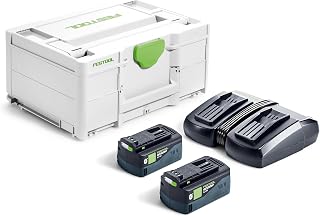


Choosing the right Festool battery and charger is about more than simply selecting the largest Ah rating. The most suitable combination depends on the cordless tool, the amount of power it demands, how long you work between charging opportunities, the importance of keeping the machine light, and whether rapid charging or simultaneous charging will make a meaningful difference to your working day. Festool's current cordless range includes compact batteries designed around handling and assembly work, 5.0 Ah high-power options aimed at general-purpose use, and higher-capacity batteries intended for demanding applications where runtime and sustained power matter more than minimum weight. The charging range similarly spans conventional rapid charging, dual-bay charging and AIRSTREAM technology designed to actively cool compatible batteries during charging. This guide expands the comparison with the technical considerations that matter when buying Festool batteries and chargers in the UK. It is designed to help you compare specifications, understand compatibility, avoid common purchasing mistakes and choose an appropriate battery-and-charger combination for your particular workload. There is no single best Festool battery for every user. A compact battery can be the better choice for prolonged overhead drilling, while a higher-capacity battery may be preferable for sawing, planing or other demanding applications. The best option is therefore the one that balances power, runtime, weight and compatibility with the tools already in your collection. The Festool BP 18 Li 5.0 HP-ASI is a particularly versatile choice for users who want one 18 V battery category that can cover a broad range of workshop and site work. It has a rated voltage of 18 V, a capacity of 5.0 Ah and a published weight of 0.70 kg. Festool positions its Li-HighPower cell technology as an option for applications requiring a combination of power and endurance, including sawing, cutting, drilling, screwdriving and planing. The battery also incorporates Bluetooth connectivity and AIRSTREAM functionality. When paired with compatible Festool equipment, Bluetooth can provide additional battery information through the Festool app and can support automatic activation of a compatible mobile dust extractor when the cordless tool is switched on. Festool states that the BP 18 Li 5.0 HP-ASI can be ready for use again in around 24 minutes when paired with the SCA 16 AIRSTREAM rapid charger. That figure should be treated as a manufacturer-published charging claim rather than a universal real-world charging time, because charging behaviour depends on the battery, charger, temperature and operating conditions. The Festool BP 18 TBX 8 ASI is aimed at users who place a high value on runtime and sustained power. Its 8.0 Ah capacity gives it substantially more stored energy than a 4.0 Ah or 5.0 Ah battery of the same voltage, although the additional capacity comes with a corresponding increase in size and weight. The TBX 8 uses tabless cell technology. Festool states that this technology is intended to reduce heat generation while supporting power delivery, longer runtimes and faster charging. The battery is also designed to work with AIRSTREAM charging, where compatible cooling technology actively cools the battery before and during charging. Festool lists the TBX 8 as suitable for 18 V applications with an emphasis on high performance and stamina, while identifying specific cordless sanders and the CTC SYS as exceptions. Always check the compatibility listing for the exact tool before purchasing rather than assuming that every 18 V Festool battery is suitable for every 18 V machine. The Festool BP 18 TBX 4 C-ASI is designed for buyers who want modern high-power battery technology without moving to the larger 8.0 Ah format. Its 4.0 Ah capacity makes it a useful middle ground when handling and machine balance are important but a small assembly battery does not provide enough energy. Festool describes the TBX 4 as a compact tabless battery intended for powerful applications where low weight and good handling remain important. The published product information gives the battery a weight of 0.60 kg and identifies it as an 18 V battery. It is also designed around AIRSTREAM charging with the SCA 16. For users who spend much of the day drilling and screwdriving, maximum Ah capacity is not necessarily the most sensible priority. The Festool BP 18 Li 3.0 C is a compact 18 V battery with a published capacity of 3.0 Ah and weight of just 0.40 kg. Festool specifically positions this battery around assembly work and lower-energy drilling and screwdriving applications. It is listed as more than 30 per cent lighter than the TBX 4 battery, making weight and handling its main advantages rather than maximum endurance. The product listing also identifies several high-demand cordless tools for which this battery is not intended, demonstrating why compatibility should be checked by exact model rather than voltage alone. The BP 18 Li 3.0 Ergo I is different from a conventional general-purpose 18 V battery because it is specifically developed for Festool's ETSC 125, RTSC 400 and DTSC 400 cordless sanders. Its ergonomic design is intended to support mobility and handling during sanding. This is an important example of why battery comparisons should consider the actual tool platform rather than simply comparing Ah figures. A battery that looks attractive on paper may not be the appropriate choice if the manufacturer specifies a specialist battery design for the tool concerned. Ah, or ampere-hours, is a measure of battery capacity. In simple terms, a higher Ah rating generally means more stored electrical energy when comparing batteries operating at the same nominal voltage and using broadly comparable technology. It does not, by itself, tell you how powerful the battery will feel in every tool. For Festool's 18 V platform, the difference between capacity classes is primarily a trade-off between runtime, weight, physical size and the type of application being undertaken. Increasing capacity is not automatically an upgrade. If a drill is used overhead for hours at a time, the weight saved by using a smaller battery can have greater practical value than additional runtime. Conversely, changing a high-demand saw or planer battery repeatedly may be far more disruptive than carrying a larger battery. Battery weight affects the overall weight of the cordless tool, not just the battery itself. This becomes particularly noticeable when drilling overhead, installing fixings at arm's length, working on ladders, sanding vertical surfaces or repeatedly lifting a tool throughout a long shift. A 3.0 Ah compact battery can therefore be the better buying decision for an assembly specialist even when a larger 5.0 Ah or 8.0 Ah battery offers longer runtime. Conversely, a heavier battery can be worthwhile when the tool spends most of its time on a workbench, floor, roof structure or other position where handling weight is less significant. When comparing batteries, consider the complete tool-plus-battery combination. A small difference in battery mass can feel considerably more important after hundreds of repetitive movements than it does when comparing specifications on a screen. Festool's current battery range includes different cell technologies, so comparing only voltage and capacity leaves out an important part of the specification. Modern Festool cordless batteries use lithium-ion technology. Lithium-ion batteries offer a high energy density relative to their size and are well suited to professional cordless power tools. Festool's Li-HighPower batteries are designed around high-current-resistant cells and are intended to provide strong power delivery while maintaining a practical battery format. The BP 18 Li 5.0 HP-ASI is positioned as an all-rounder for demanding applications and uses Bluetooth and AIRSTREAM functionality. Festool states that the 5.0 Ah Li-HighPower battery can provide up to 50 per cent more power than its 5.0 Ah standard battery in certain newer saws and the HLC 82 cordless planer. This is an application-specific manufacturer claim, not a universal statement that every tool will produce 50 per cent more output. Tabless cell construction is used in Festool's newer TBX batteries. The basic idea is to improve the electrical path within the cell architecture, helping to reduce resistance and heat while supporting high power delivery. For buyers, the practical question is not whether tabless technology sounds more advanced, but whether the benefits matter for the intended work. It becomes particularly relevant when a tool has high power demands, when battery temperature affects charging availability, or when faster charging between jobs is valuable. One of the most important rules when comparing Festool batteries is that an 18 V rating alone does not guarantee compatibility with every Festool cordless product. Festool's product pages explicitly list exclusions for individual battery models. For example, some general-purpose 18 V batteries are not intended for the ETSC 125, RTSC 400 and DTSC 400 sanders, while other batteries have further exclusions involving specific saws, extractors or specialist equipment. Before buying, identify the exact cordless tool model and then verify the battery compatibility stated by Festool. This is especially important when buying an older battery for an established tool, mixing newer battery technology with an existing collection, or purchasing from a marketplace where product descriptions may be abbreviated. A battery is only half of the cordless power system. Charger choice affects turnaround time, socket usage, portability and how efficiently a collection of batteries can be managed during a working day. The Festool TCL 6 is a straightforward option for users who need one charger for their compatible battery collection. Festool lists it for battery packs in the 10.8 V to 18 V classes, with specific exceptions including BP-XS battery packs associated with CXS and TXS systems that use the MXC charger. The TCL 6 has a published charging current of 6.0 A and an LED display that indicates charging progress and remaining charging time. Its housing also incorporates a cable holder and mounting points for wall installation. For a typical workshop user with a modest number of batteries, the TCL 6 can make more sense than paying for a more advanced charger whose additional capabilities will rarely be used. The TCL 6 DUO is designed around two charging bays, allowing two compatible battery packs to be charged at the same time. Festool specifies a charging current of 2 x 6.0 A for the charger. The two-bay arrangement can be particularly useful for tools that use two 18 V batteries, as both batteries can be charged simultaneously rather than waiting for one to finish before starting the next. It can also simplify site work because two chargers are not required merely to charge two batteries at once. Festool states that the TCL 6 DUO is compatible with a wide range of battery packs across its 10.8 V, 14.4 V and 18 V classes, subject to stated exceptions. The SCA 16 is the charger to consider when charging speed and battery cooling are major priorities. Festool lists a 16 A charging current and an input voltage of 220–240 V for the UK version. Its distinguishing feature is AIRSTREAM cooling. The charger actively cools compatible battery packs before and during charging, helping the charging system maintain high charging performance when conditions allow. Festool specifically promotes the SCA 16 for fast charging of 18 V batteries and highlights its suitability for the newer TBX batteries. For users who run a professional cordless system continuously, the value of a fast charger is not simply the time shown on a specification sheet. The real benefit is reducing the amount of spare battery capacity required to maintain continuous work. The SYS-MC 6/4 is designed for users managing several batteries rather than just one or two. Festool describes it as a multi-charger capable of charging up to four compatible batteries simultaneously and in parallel from one socket. This can be particularly useful in workshops, vehicles and construction environments where socket availability and battery organisation are recurring problems. The charger is also designed around Systainer integration, making it attractive to users already invested in Festool's storage and transport system. Festool identifies exceptions including BP-XS batteries associated with CXS and TXS systems and BP Ergo battery packs. The MXC should not be selected simply because it is a Festool charger. It is specifically designed for BP-XS battery packs used with certain CXS and TXS cordless drills, with Festool also identifying exclusions for newer CXS/TXS 12 and CXS/TXS 18 systems. Its published charging current is 2.8 A. The key advantage is correct compatibility with the relevant compact battery system rather than maximum charging throughput across the wider Festool range. AIRSTREAM is more than a marketing name for a faster charger. The system uses active air cooling to manage battery temperature before and during charging. Battery temperature is important because lithium-ion cells cannot simply be charged at maximum speed under every thermal condition. The practical advantage is greatest for users who repeatedly finish a battery-intensive task and need the battery back in service quickly. If a battery has to cool naturally for a significant period before rapid charging can proceed, the theoretical capacity of the charger is less relevant. Active cooling is intended to reduce that bottleneck. For occasional DIY use, the additional charging performance may not justify choosing the most advanced charger. For professional users who rotate several batteries throughout the day, faster turnaround can have considerably more practical value. Battery runtime varies according to the tool, material, cutting or drilling load, accessory, operating technique, temperature and the condition of the battery. A 5.0 Ah battery should not be expected to deliver an identical runtime across a drill, circular saw, planer and sander. Power demand also changes throughout a task. A saw cutting thick hardwood can place a very different demand on a battery from a drill driving small fixings into softwood. Consequently, published Ah capacity is best used as a comparison of stored capacity rather than a promise of a particular number of minutes of operation. When comparing batteries, think in terms of workload rather than simply runtime. Ask how many cuts, fixings, holes or sanding sessions you need between charging opportunities and whether changing batteries is genuinely disruptive. Battery placement and mass can influence how a cordless tool feels in the hand. A larger battery may extend runtime but can alter the balance of a compact drill or increase fatigue during repeated overhead work. For screwdriving and light assembly, a compact 3.0 Ah battery may provide a more comfortable combination. For general site work, 5.0 Ah is a more balanced capacity class. For high-demand cutting and planing, an 8.0 Ah battery can be more appropriate where additional runtime and power are more important than minimum weight. The correct choice is therefore application-specific rather than hierarchical. Bigger should not automatically be interpreted as better. Some Festool batteries include Bluetooth connectivity. This can add useful integration for users who operate compatible Festool dust extractors and want additional battery information. With compatible equipment, a Bluetooth-enabled battery can communicate with a paired mobile dust extractor so that the extractor starts when the cordless tool is switched on. The Festool app can also provide information such as battery charge status and certain operating data, including temperature and charge cycles, depending on the compatible battery and system. This feature should be considered a workflow benefit rather than a reason to select a battery solely on connectivity. If automatic extractor activation and battery monitoring are useful to your work, Bluetooth can be valuable. If the battery will be used only for straightforward drilling away from a compatible extractor, the feature may have less importance. Festool offers battery-and-charger combinations in addition to individual batteries and chargers. Energy sets can be attractive when starting or expanding an 18 V collection because they combine multiple battery packs with a charger and, in some configurations, Systainer storage. Current examples include sets containing two BP 18 Li 5.0 HP-ASI batteries with a TCL 6 charger, as well as configurations using two 5.0 Ah batteries and the TCL 6 DUO. Festool also offers newer energy sets using TBX batteries and the SCA 16 rapid charger. For an established user, the calculation is different. If you already have several batteries and chargers, an energy set may duplicate equipment you do not need. Compare the individual components and the kit contents rather than assuming a bundled configuration is automatically better value. There is no universal number. The right quantity depends on tool consumption, the length of the working day, access to mains power, charger speed and whether work can continue while batteries are charging. A useful way to assess the requirement is to consider the charging cycle rather than simply counting tools. If your batteries routinely become empty before a charged replacement is ready, you need either more battery capacity, more batteries, faster charging or a combination of these. An 8.0 Ah battery is not automatically the best choice. Additional capacity usually brings additional weight, and that can be counterproductive for repetitive drilling, screwdriving or overhead work. Voltage is only one part of compatibility. Festool publishes specific application restrictions for several batteries, so always check the exact tool and battery combination before buying. A very fast single-bay charger may be less convenient than a dual charger if two batteries must routinely be ready at the same time. Conversely, a dual charger may not offer the fastest possible turnaround for a single high-capacity battery. On a busy site, socket availability can be a surprisingly important consideration. A multi-bay charger can simplify battery management when several packs need charging simultaneously. The MXC is a good example of why charger compatibility matters. It is designed for specific BP-XS battery packs rather than being a general replacement for the TCL or SCA charging range. Before buying a new battery and charger combination, inventory the batteries already in the workshop. If the existing packs are compatible with the new charger, a charger upgrade alone may solve the problem. When comparing products, the following specification checklist provides a more useful assessment than looking at price alone. A compact battery and conventional charger can be perfectly adequate when tools are used intermittently. Spending more on the highest-capacity battery or fastest charger only makes sense if the additional runtime or charging speed will actually be used. Weight, handling and battery balance are often more important than maximum capacity. A compact 3.0 Ah option can be particularly attractive for drilling and screwdriving, while a 5.0 Ah battery provides a stronger all-round solution when the same battery is also used for more demanding work. A pair of 5.0 Ah high-power batteries provides a practical starting point for users who want a balance between runtime and portability. A TCL 6 DUO can be useful where two batteries need to be replenished at the same time. Higher-capacity batteries become more compelling when tools place substantial demands on the power supply. Festool positions the 8.0 Ah TBX battery for applications requiring high performance and stamina, making it a strong candidate where maximum runtime is a priority. Battery management becomes a system rather than an accessory decision. Multiple batteries, rapid charging, simultaneous charging and organised storage can all reduce interruptions. The SCA 16 and SYS-MC 6/4 are particularly relevant to different aspects of this type of workflow. Good battery management can help maintain a reliable cordless system over time. Always follow the manufacturer's operating, charging, storage and transport instructions for the specific battery. Battery temperature can influence charging behaviour and performance. This is one reason AIRSTREAM cooling is relevant to high-speed charging, while environmental conditions should still be considered when planning cordless work. Do not interpret a rapid charger specification as a guarantee that every battery will charge at the same speed in every environment. Thermal management, battery condition and charger compatibility all influence the actual charging cycle. If you are starting a Festool cordless collection, it is sensible to choose batteries around your most demanding tool rather than buying one battery type for every possible future purchase. Start by identifying the tools you expect to use most frequently. If most of your work involves drilling and screwdriving, prioritise low weight and handling. If your collection includes saws and other power-hungry tools, consider a higher-capacity or high-power battery. If you expect to use several cordless machines continuously, prioritise charger throughput and battery rotation. Once the core batteries have been selected, choose the charger that fits the working pattern. A single TCL 6 may be sufficient for a small collection, whereas a TCL 6 DUO, SCA 16 or SYS-MC 6/4 may provide greater practical value as the number of batteries increases. When reading verified customer reviews, look beyond star ratings. Reviews are most useful when they describe the workload, tool and battery combination involved. A review saying that a battery lasts a long time is difficult to interpret without knowing which tool, material and workload were involved. Similarly, a complaint about charging speed may reflect use of a different charger or an unsuitable charging environment. Context matters. The most useful comparison is not necessarily between the smallest and largest battery. It is between the battery capacity that supports your workload and the battery capacity that creates unnecessary weight. For many users, 5.0 Ah represents a sensible middle ground because it provides more endurance than compact batteries without moving as far into the weight and size associated with the largest capacities. Users with demanding applications may reasonably favour 8.0 Ah, while assembly specialists may gain more from a lightweight 3.0 Ah option. The best purchasing decision is therefore workload-led. Capacity should be selected according to how the tool is used, not simply because a higher number appears better in a product comparison. There is no single best battery for every Festool tool. The BP 18 Li 5.0 HP-ASI is a strong all-round option for many 18 V applications, while the BP 18 TBX 8 ASI is aimed at users prioritising high performance and stamina. Compact options such as the BP 18 Li 3.0 C are more appropriate when low weight and handling are the priority. Not necessarily. A 5.0 Ah battery generally provides greater stored capacity, but a 4.0 Ah battery can offer an attractive balance between runtime and weight. The TBX 4 also uses tabless cell technology, so capacity alone does not describe the complete battery specification. It can be worthwhile for demanding cordless applications where long runtime and sustained power are more important than minimum weight. For lightweight drilling or repetitive overhead work, a smaller battery can be easier to handle. The TCL 6 is a single-bay rapid charger, whereas the TCL 6 DUO has two charging bays and can charge two compatible batteries simultaneously. The DUO is particularly useful for users who need two batteries ready together or who want to avoid using two separate chargers. The SCA 16 is a 16 A AIRSTREAM rapid charger designed for compatible Festool batteries. It actively cools compatible batteries before and during charging to support fast charging and is particularly relevant to the newer high-performance battery range. Yes. Festool lists the TCL 6 for compatible battery packs in the 10.8 V to 18 V voltage classes, subject to specific exclusions. Always check the exact battery model before charging it. Yes. The TCL 6 DUO has two charging bays and is designed to charge two compatible battery packs simultaneously. Festool lists the SCA 16 for compatible battery packs in the 10.8 V to 18 V classes, with specific exceptions. Specialist systems should always be checked against the current manufacturer compatibility information. The MXC is a specialist charger for BP-XS battery packs used with certain CXS and TXS systems. It should not be treated as the general-purpose charger for Festool's wider 18 V battery range. Two batteries provide a useful basic rotation for many users, but demanding professional workloads can justify three, four or more. The ideal number depends on battery capacity, tool power consumption, charger speed and how continuously the tools are used. Ah primarily describes capacity rather than directly defining power output. Battery cell technology and the battery's ability to deliver current also matter. Festool's Li-HighPower and tabless battery technologies are designed for high power delivery in appropriate applications. Bluetooth can be useful if you use compatible Festool dust extraction equipment or want additional battery information through the Festool app. It is less important if your priority is simply powering a cordless tool and you do not use the connected features. Check the exact model number, voltage, Ah capacity, weight, compatibility list, technology, Bluetooth functionality and any stated exclusions. Also verify that the charger you already own is compatible. Do not rely solely on a marketplace title or a generic description saying that a battery is for all Festool 18 V tools. The best Festool battery and charger combination is the one that fits the way you actually work. For general-purpose 18 V use, a 5.0 Ah high-power battery offers a compelling balance of power, endurance and portability. Compact 3.0 Ah batteries make more sense where low weight and handling dominate, while TBX batteries are worth considering when high power, reduced heat generation and rapid AIRSTREAM charging are particularly relevant. Charger selection should follow the same principle. TCL 6 is a straightforward all-round option, TCL 6 DUO makes sense when two batteries need to be charged together, SCA 16 is focused on rapid AIRSTREAM charging, SYS-MC 6/4 suits larger battery collections, and MXC is a specialist solution for the appropriate BP-XS system. Before buying, compare the exact battery and charger specifications against your tools, consider how many batteries your working day actually requires, and check the latest manufacturer compatibility information. Comparing the complete cordless system rather than chasing the highest Ah number is the most reliable way to choose the right Festool battery and charger for professional work in the UK.Festool Battery and Charger Buying Guide for the UK
Best Festool Battery Options by Type of Work
Best all-round option: Festool BP 18 Li 5.0 HP-ASI
Best for maximum endurance: Festool BP 18 TBX 8 ASI
Best compact high-power option: Festool BP 18 TBX 4 C-ASI
Best for lightweight drilling and screwdriving: Festool BP 18 Li 3.0 C
Specialist choice for Festool cordless sanders: BP 18 Li 3.0 Ergo I
Festool Battery Capacity Explained: 3.0 Ah, 4.0 Ah, 5.0 Ah and 8.0 Ah
Battery Weight Matters More Than Many Buyers Expect
Standard Lithium-Ion, Li-HighPower and Tabless Technology
Li-ion battery technology
Li-HighPower technology
Tabless cell technology
Festool Battery Compatibility: What to Check Before Buying
Festool Chargers Compared
Festool TCL 6: the conventional all-round rapid charger
Festool TCL 6 DUO: best for charging two batteries simultaneously
Festool SCA 16: the AIRSTREAM rapid charger
Festool SYS-MC 6/4: best for larger battery collections
Festool MXC: a specialist charger rather than a general-purpose 18 V choice
Which Festool Charger Should You Buy?
AIRSTREAM Explained: Is It Worth Paying More For?
Battery Runtime: Why Ah Is Not the Whole Story
Battery Size Versus Tool Balance
Bluetooth Battery Features and Dust Extraction
Festool Energy Sets: When a Kit Makes More Sense Than Individual Batteries
How Many Festool Batteries Do You Actually Need?
Common Festool Battery Buying Mistakes
Buying purely on Ah rating
Assuming every 18 V Festool battery is interchangeable
Choosing the charger based only on advertised charging speed
Ignoring the number of charging sockets available
Buying a specialist charger for the wrong battery system
Overlooking existing batteries
Festool Battery and Charger Comparison Criteria
Battery and Charger Combinations for Different Users
For occasional DIY users
For joinery and furniture assembly
For carpentry and site work
For heavy-duty cutting and planing
For high-volume professional use
Battery Care and Maintenance
Charging in Cold or Hot Conditions
How to Build a Festool 18 V Battery System Efficiently
Festool Battery Buying Checklist
Festool Charger Buying Checklist
Festool Battery and Charger Reviews: What to Look For
Festool Versus Buying the Largest Battery Available
Frequently Asked Questions
What is the best Festool battery?
Is a Festool 5.0 Ah battery better than a 4.0 Ah battery?
Is the Festool 8.0 Ah battery worth buying?
What is the difference between Festool TCL 6 and TCL 6 DUO?
What is the Festool SCA 16 charger?
Can the Festool TCL 6 charge 18 V batteries?
Can the Festool TCL 6 DUO charge two batteries at once?
Can the Festool SCA 16 charge every Festool battery?
Is the Festool MXC charger suitable for 18 V batteries?
How many Festool batteries should I have?
Does a higher Ah battery give a cordless tool more power?
Are Festool Bluetooth batteries worth it?
What should I check before buying a Festool battery online?
Final Buying Advice