

Our experts reviewed the latest {category_name } to help you compare quality, performance, durability and overall value before making your purchase.


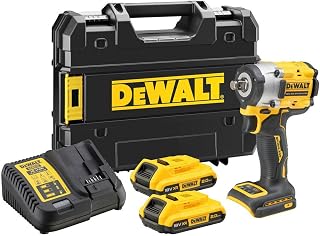


Choosing a DEWALT cordless impact wrench is less about finding the largest torque figure and more about matching the tool to the fasteners, access conditions and frequency of use. The current UK range spans compact 18V XR models for confined spaces, mid-torque machines for general mechanical work and substantially more powerful high-torque models for demanding fastening and removal applications. DEWALT's UK range also includes 12V models, 3/4-inch drive machines and different anvil-retention systems, so model names alone do not tell the whole story. For most buyers, the most useful comparison starts with five questions: how much torque is actually required, how much space is available around the fastener, whether a 1/2-inch or 3/4-inch drive is appropriate, whether you already own compatible DEWALT batteries, and whether you need a bare tool or a complete kit. Torque is one of the most commonly misunderstood specifications when comparing cordless impact wrenches. A product may quote fastening torque, maximum torque and breakaway torque, but these figures describe different aspects of performance and should not be treated as interchangeable. Fastening torque indicates the manufacturer's stated capability for driving a fastener under specified conditions. It is useful when comparing models within the same product family, but it should not be interpreted as a universal guarantee that every fastener will be tightened to that figure in every application. Breakaway torque is particularly relevant when an impact wrench is being considered for loosening stubborn bolts. The figure can be substantially higher than the fastening torque. For example, DEWALT specifies the DCF921 at 406Nm fastening torque and 610Nm breakaway torque, while the DCF900 is specified at 1,396Nm fastening torque and 1,898Nm breakaway torque. This distinction explains why a compact wrench can be highly capable for routine work while still being unsuitable for heavily seized or exceptionally large fasteners. If difficult removal is a major part of the job, breakaway capability deserves as much attention as the headline fastening figure. More torque can mean greater capability, but it can also mean a larger, heavier tool and a greater need for careful control. A high-torque wrench can be unnecessary for applications where a compact model already provides sufficient capacity. For workshop, automotive and maintenance work, the best choice is often the smallest model that comfortably covers the required fastening range. A shorter head can make a greater practical difference than an additional few hundred newton metres when working between components or inside wheel arches. The DCF921 and DCF922 occupy the same compact performance class. Both are 18V XR brushless 1/2-inch impact wrenches with a 125mm body and stated output of up to 406Nm fastening torque and 610Nm breakaway torque. The principal distinction is the socket-retention arrangement. The DCF921 uses a hog ring anvil, while the DCF922 uses a detent pin. Neither arrangement is automatically superior for every user. If you regularly swap between sockets during maintenance work, the DCF921's hog ring may be the more convenient choice. If secure retention is particularly important, the DCF922's detent pin may be preferable. The DCF891 represents a significant step up in output from the compact DCF921. DEWALT specifies up to 812Nm fastening torque and 1,084Nm breakaway torque for the DCF891, compared with 406Nm and 610Nm respectively for the DCF921. The DCF891 is also longer at 175mm, compared with the DCF921's 125mm body. This makes the comparison less about which tool is technically better and more about the type of work being performed. The DCF900 and DCF961 are aimed at buyers who need substantially more power than compact and mid-torque models. The DCF900 is specified at up to 1,396Nm fastening torque and 1,898Nm breakaway torque, with a 223mm product length. The DCF961 moves the performance ceiling higher, with DEWALT listing up to 1,626Nm fastening torque and 2,372Nm breakaway torque. Its product information also describes a power increase after four seconds of impacting to assist with stubborn fasteners, alongside Precision Wrench and multiple operating modes. For buyers comparing the two, the DCF961 is the more compelling choice when maximum stated output is a primary requirement. The DCF900 remains a substantial high-torque option for demanding applications where its specification is sufficient. A high-torque wrench is not automatically the best choice for routine vehicle maintenance. If the majority of your work involves standard wheel fasteners, general mechanical assemblies or medium-sized fixings, the additional size and weight may provide little practical benefit. High-torque models make more sense when applications involve large fasteners, heavy equipment, structural work, stubborn threaded connections or situations where a lower-powered wrench regularly reaches its limits. Drive size should be considered alongside torque rather than treated as a simple indication of tool quality. A 1/2-inch impact wrench is highly versatile for automotive and general mechanical applications, while a 3/4-inch drive becomes more relevant as socket sizes and fastening loads increase. DEWALT's UK catalogue currently lists both 1/2-inch high-torque models and 3/4-inch high-torque models, giving buyers a choice based on the required socket system rather than torque alone. One of the easiest mistakes when comparing cordless tools is comparing the price or specification of a bare unit with that of a complete kit as though they were equivalent purchases. A bare DEWALT impact wrench is supplied without the battery and charger required to operate it. This can be an advantage for existing DEWALT 18V XR users because there is no need to buy another charger or duplicate batteries. DEWALT lists bare versions of several models, including the DCF921, DCF922 and DCF899. Complete kits can include one or more batteries, a charger and sometimes a TSTAK case. For example, the DCF900P2T-GB is supplied with two 5Ah batteries, a charger and TSTAK box, while the DCF961H2T-GB is supplied with two 5Ah POWERSTACK batteries, a charger and TSTAK box. For buyers already invested in the DEWALT 18V XR ecosystem, a bare impact wrench can be particularly attractive because the battery platform can be shared across compatible tools. However, compatibility should always be checked against the precise tool and battery specification before purchase rather than assumed from appearance or voltage alone. Battery capacity also influences the overall handling characteristics of a cordless impact wrench. A larger-capacity battery can increase runtime potential, but it also adds weight. On a compact wrench, the difference can affect balance and comfort during prolonged use. The right battery depends on the application. A smaller pack can be attractive when keeping the tool light is important, whereas a higher-capacity pack may make more sense for demanding or extended use. DEWALT's UK product range demonstrates that the same tool family may be offered in different battery configurations, including 2Ah and 5Ah kits and newer POWERSTACK combinations. Do not assume that the largest battery is automatically the best choice. For overhead work, repeated repositioning or confined access, reduced weight may be more valuable than maximum runtime. Current DEWALT XR impact wrench models such as the DCF921, DCF922, DCF891, DCF900 and DCF961 use brushless motor technology. DEWALT describes its brushless motors as delivering high performance while allowing a shorter design and helping extend tool life. For a buyer, the important practical point is that motor technology is only one part of the equation. A brushless motor does not make every model equally powerful. The drive mechanism, electronic controls, gearing, battery system, physical dimensions and operating modes all contribute to the final tool's behaviour. Torque is not the only specification worth comparing. No-load speed and impact rate help explain how quickly an impact wrench operates, while selectable modes allow the user to adapt the tool to different applications. The compact DCF921, for example, is specified at up to 2,500rpm and 3,550 impacts per minute. The DCF891 reaches up to 2,000rpm and 3,250 impacts per minute, while the DCF900 is specified at up to 2,300rpm and 2,200 impacts per minute. These numbers should not be read in isolation. A higher impact rate does not necessarily make one tool universally better. For many applications, controllability, access and torque management are more important than the highest possible impact frequency. Some DEWALT high-torque impact wrenches include Precision Wrench functionality intended to give the user greater control over fastening and loosening behaviour. The DCF900 includes Precision Wrench mode, and the DCF961 also provides Precision Wrench alongside multiple operating modes. These modes are particularly relevant when an impact wrench is being used for more than simply removing stubborn nuts. Controlled operation can help reduce the risk of excessive fastening or uncontrolled fastener run-off, but users should still follow the requirements of the particular application. An impact wrench should not automatically be treated as a substitute for a calibrated torque wrench when a specified final tightening torque is required. Where a manufacturer, vehicle maker or engineering procedure specifies a precise torque value, use the appropriate torque-controlled procedure and verify the relevant instructions. The DCF921 includes a four-mode switch with Scaffold Mode, giving it a particular point of interest for users who work with scaffolding fasteners. This illustrates an important buying principle: the most useful feature is often the one that matches your work. A buyer who regularly performs a specific type of fastening should examine the available control modes rather than choosing solely from torque figures. Tool length can have a major practical effect. The DCF921 and DCF922 have a 125mm body length, while the DCF891 is specified at 175mm and the DCF900 at 223mm. The DCF961 is listed with a product length of 213mm on DEWALT's UK specification page. A longer tool can make it difficult to reach a fastener that sits behind suspension components, inside a chassis area or close to other obstructions. In those situations, a lower-torque compact wrench may complete the job more effectively than a substantially more powerful model that cannot physically fit. Before buying, consider the actual clearance around the fasteners you work on. Measuring the available space can be more useful than simply comparing published torque ratings. Weight becomes increasingly important when an impact wrench is used repeatedly or held away from the body. DEWALT lists the DCF921 at approximately 1.1kg, the DCF891 at approximately 1.67kg and the DCF900 at approximately 2.9kg in the cited UK specifications; these figures should be checked against the exact configuration because battery weight and kit contents vary. A heavier high-torque wrench can be entirely appropriate for heavy engineering work while being unnecessarily tiring for lighter maintenance. Conversely, choosing an ultra-compact tool solely because it is easier to carry can lead to frustration if the tool lacks sufficient capacity for the fasteners involved. Socket retention is a small specification with a surprisingly large effect on day-to-day usability. DEWALT offers both systems across its 1/2-inch impact wrench range. A hog ring is designed for quick socket changes and is particularly convenient for users who regularly move between different sizes. A detent pin provides positive retention and can be preferable where keeping the socket securely attached is a priority. There is no universal winner. The better system depends on how frequently you change sockets and how much importance you place on rapid changes versus positive retention. The DCF899 remains an important reference point when comparing DEWALT impact wrenches because it established a widely recognised high-torque specification. DEWALT's UK site identifies several DCF899 variants as discontinued, while also listing a current DCF899HNT-XJ hog-ring version. The current DCF899HNT-XJ specification lists up to 950Nm fastening torque and 1,625Nm breakaway torque, with three speed and torque settings and a 224mm product length. This makes model-number verification particularly important when shopping for an older or clearance DEWALT impact wrench. Two listings may both be described as a DCF899 while differing in anvil type, battery configuration, regional suffix or availability status. Typical applications can include vehicle maintenance, wheel fastener removal, machinery maintenance, construction fastening, structural work and general mechanical tasks. The appropriate model depends heavily on the fastener size, required torque and physical access. A 1/2-inch model is usually the logical starting point for automotive users. Compact models such as the DCF921 and DCF922 are particularly attractive where access is restricted, while a mid-torque DCF891 provides substantially more stated torque without moving to the dimensions of the largest high-torque models. For heavy-duty vehicle, plant or stubborn-fastener work, a high-torque model may be justified. However, final wheel-nut tightening should follow the vehicle manufacturer's specified procedure rather than relying solely on an impact wrench's maximum torque rating. High-torque models become more relevant as fastener sizes and fastening loads increase. DEWALT specifically positions the DCF900 for applications including large pipe flanges, grooved couplings, wheel lugs and concrete anchor bolt setting. For heavier industrial applications, buyers should also consider whether a 3/4-inch drive is more appropriate than a 1/2-inch machine. DEWALT's current UK range includes 3/4-inch high-torque options. Maximum torque is only one part of the decision. A high-torque tool can be heavier, longer and less convenient in confined areas. A large breakaway number does not mean the tool should be used to tighten fasteners to that same figure. Treat fastening and breakaway ratings as separate specifications. Check the available clearance before buying. A compact model can outperform a larger tool in practical terms simply because it can reach the fastener. Check whether the tool uses a hog ring or detent pin and consider how you normally change and retain sockets. A bare unit may look substantially cheaper until the cost of adding compatible batteries and a charger is considered. Existing DEWALT users should calculate the value differently from someone starting a cordless system from scratch. The battery is part of the tool you actually hold. A specification that looks excellent on paper can feel very different once a high-capacity battery is fitted. DEWALT's UK catalogue contains current and discontinued variants. Always verify the exact model number and current status before making a purchasing decision. DEWALT model numbers can appear complicated because the same basic tool may be sold as a bare unit or in several battery and case configurations. The underlying model designation identifies the tool family, while suffixes can distinguish packaging, batteries, regional configurations or other variations. For example, the DCF921 appears as a bare unit as well as in DCF921D2T-GB and DCF921P2T-GB configurations. The former is supplied with two 2Ah batteries and TSTAK, while the latter is supplied with two 5Ah batteries and TSTAK. Consequently, buyers should compare the full product code rather than stopping at the first four digits of the model number. Good maintenance starts with keeping the tool, battery contacts and accessories clean and dry. Inspect the anvil, socket-retention mechanism and housing regularly, particularly if the wrench is used in dusty, wet or dirty environments. DEWALT's DCF900 manual specifically warns that impact accessories should be used with the tool and that accessories should be inspected for damage before use. Impact wrenches generate repeated high-energy impacts. Standard hand-tool sockets are not automatically suitable simply because they fit the square drive. Use accessories designed and rated for impact applications and follow the accessory manufacturer's instructions. The correct socket size also matters. A poorly fitting socket can damage the fastener and increase the risk of the socket slipping or failing. For professional or repeated use, buying a quality set of impact-rated sockets can therefore be just as important as choosing the wrench itself. Impact wrenches are powerful tools and should be used according to the manufacturer's safety instructions. Wear appropriate eye protection, use suitable impact accessories and maintain a stable working position. Keep hands clear of the fastener and reaction areas and make sure the socket is properly seated before operating the tool. For applications involving safety-critical fasteners, always follow the equipment or vehicle manufacturer's specified tightening procedure. An impact wrench's maximum torque rating is not a substitute for an application-specific torque specification. Prioritise compact dimensions, ease of handling and compatibility with any batteries you already own. A compact 1/2-inch model may provide a better overall experience than a high-torque wrench that is rarely used at its full capacity. Look closely at the balance between access and torque. A DCF921 or DCF922 is compelling where compactness is important, while the DCF891 offers considerably more torque for demanding mechanical work. Consider whether one compact and one high-torque wrench would cover a wider range of work more effectively than a single compromise model. The compact tool can handle restricted access while the high-torque machine handles demanding fasteners. Prioritise torque headroom, drive size, battery capacity, ergonomics and serviceability. The DCF900 and DCF961 sit firmly in the high-torque category, while DEWALT also offers 3/4-inch high-torque models for applications requiring a larger drive. Some buyers try to find one impact wrench capable of every task. That approach can produce a tool that is powerful enough for heavy work but awkward for routine jobs. A compact-plus-high-torque combination can be more versatile. A compact 1/2-inch wrench can handle access-sensitive tasks, while a high-torque machine can be kept for larger or stubborn fasteners. Whether that makes financial sense depends on how frequently each tool will be used and whether the buyer already owns compatible batteries. As of August 2026, DEWALT's UK impact-wrench catalogue includes a broad mixture of compact, mid-torque and high-torque 18V XR machines, alongside 12V and 3/4-inch options. The catalogue also includes different battery configurations and some older or discontinued variants. For an up-to-date comparison, check the exact product code, specification sheet and kit contents immediately before purchase. Product ranges can change, and a retailer listing may refer to an older configuration even when a newer model is now available. There is no single best model for every buyer. The DCF921 and DCF922 are strong choices when compactness is important, the DCF891 is a higher-output mid-torque option, and the DCF900 and DCF961 are aimed at substantially more demanding applications. The DCF921 is specified at up to 406Nm fastening torque and 610Nm breakaway torque, making it a capable compact 1/2-inch option. Whether that is sufficient depends on the particular vehicle, fastener condition and application. Both are compact 18V XR brushless 1/2-inch models with the same stated 406Nm fastening torque, 610Nm breakaway torque and 125mm body length. The key distinction is the anvil: the DCF921 uses a hog ring and the DCF922 uses a detent pin. Yes, based on DEWALT's stated specifications. The DCF891 is rated at up to 812Nm fastening torque and 1,084Nm breakaway torque, compared with 406Nm and 610Nm for the DCF921. The trade-off is a larger 175mm body compared with 125mm for the DCF921. Yes. DEWALT classifies the DCF900 as an 18V XR 1/2-inch high-torque impact wrench. Its UK specification lists up to 1,396Nm fastening torque and 1,898Nm breakaway torque. According to DEWALT's published UK specifications, yes. The DCF961 is listed at up to 1,626Nm fastening torque and 2,372Nm breakaway torque, compared with 1,396Nm and 1,898Nm for the DCF900. If you already own compatible DEWALT batteries and a charger, a bare unit may be the more practical configuration. If you are starting from scratch, compare the cost and contents of a complete kit, including batteries, charger and case. It depends on your priorities. Hog rings generally favour quick socket changes, whereas detent pins provide positive socket retention. Choose the system that matches how you work rather than treating either design as universally superior. Not automatically. An impact wrench can be extremely useful for fastening and removal, but applications requiring a specified final torque should follow the appropriate torque-controlled procedure and manufacturer instructions. Use a compatible DEWALT battery specified for the particular tool. Smaller packs can reduce overall weight, while higher-capacity packs can be useful for demanding or extended work. Check the exact model and battery compatibility before purchase. They can be, particularly where the specification and price make sense, but check the exact model status and configuration. DEWALT's UK catalogue contains both current and discontinued variants, so an older product listing should not be evaluated solely from the model family name. The best DEWALT cordless impact wrench is the one that gives you sufficient torque without sacrificing access, control or everyday usability. For confined spaces, the compact DCF921 and DCF922 deserve attention. For a stronger general-purpose option, the DCF891 occupies the middle ground. For genuinely demanding fastening and removal work, the DCF900 and DCF961 provide substantially greater stated output. Before purchasing, compare the exact model code, anvil design, torque figures, body length, weight, battery configuration, charger, storage case and current availability. Then compare today's prices from trusted UK retailers and check verified customer reviews for the exact configuration rather than relying on reviews of a different battery or anvil variant. Most importantly, do not select an impact wrench simply because it has the largest number on the specification sheet. Matching torque, size, drive system, battery platform and control features to the actual work is what produces the most useful tool for the job.How to Choose the Right DEWALT Cordless Impact Wrench
Quick Comparison: Which DEWALT Impact Wrench Type Makes Sense?
Understanding DEWALT Impact Wrench Torque Ratings
Fastening Torque
Breakaway Torque
Why a Bigger Torque Number Is Not Always Better
DCF921 vs DCF922: Compact DEWALT Impact Wrenches Compared
Hog Ring vs Detent Pin
DCF891 vs DCF921: Mid-Torque or Compact?
DCF900 vs DCF961: High-Torque DEWALT Comparison
When Does High Torque Become Excessive?
1/2-Inch vs 3/4-Inch DEWALT Impact Wrenches
Battery Choice: Bare Unit vs Complete Kit
How to Compare Kit Contents Properly
DEWALT XR Battery Compatibility and the Importance of Existing Batteries
2Ah, 5Ah and POWERSTACK Batteries
Brushless Motors: What the Specification Actually Means
Speed, Impact Rate and Torque Control
Precision Wrench and Electronic Control Modes
Scaffold Mode and Application-Specific Controls
Head Length and Access: An Often-Overlooked Specification
Weight and Ergonomics
Ergonomic Features Worth Checking
Hog Ring vs Detent Pin: Which Socket Retention System Is Best?
DEWALT DCF899: Is the Older High-Torque Model Still Relevant?
Why Discontinued Status Matters
What Should a Good DEWALT Impact Wrench Be Used For?
For Automotive Work
For Construction and Engineering
Common Buying Mistakes to Avoid
1. Choosing the Highest Torque Figure Automatically
2. Confusing Breakaway Torque with Tightening Torque
3. Ignoring Tool Length
4. Buying the Wrong Anvil
5. Comparing Bare Tools with Kits
6. Ignoring Battery Weight
7. Assuming Every Listing Is Current
How to Read a DEWALT Model Number
Specifications Checklist Before You Buy
Maintenance and Care for a Cordless Impact Wrench
Why Impact-Rated Sockets Matter
Safety Considerations When Using a Cordless Impact Wrench
How to Compare DEWALT Impact Wrenches by User Type
Best Approach for the Occasional DIY User
Best Approach for the Automotive Enthusiast
Best Approach for a Professional Workshop
Best Approach for Heavy-Duty Trade Work
When a Two-Tool Strategy Makes More Sense
How to Compare Current DEWALT Models in 2026
Recommended Comparison Process
DEWALT Cordless Impact Wrench Buying Guide: Key Takeaways
Frequently Asked Questions
Which DEWALT cordless impact wrench is best?
Is the DEWALT DCF921 powerful enough for automotive work?
What is the difference between DCF921 and DCF922?
Is the DCF891 more powerful than the DCF921?
Is the DCF900 a high-torque impact wrench?
Is the DCF961 more powerful than the DCF900?
Should I buy a bare DEWALT impact wrench or a kit?
Is hog ring or detent pin better?
Can an impact wrench replace a torque wrench?
What battery should I use with a DEWALT 18V impact wrench?
Are older DEWALT impact wrenches still worth considering?
Final Buying Advice