

Our experts reviewed the latest {category_name } to help you compare quality, performance, durability and overall value before making your purchase.


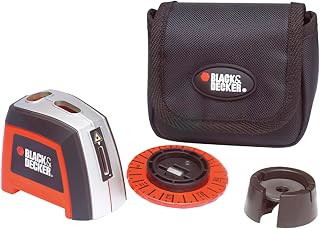

Choosing a BLACK+DECKER laser level is less about finding the longest specification sheet and more about matching the tool to the work you actually intend to do. A compact manual laser can be perfectly suitable for hanging shelves, pictures, blinds and decorative items, while a self-levelling cross-line or multi-line laser is much better suited to repeated installation and alignment work. For UK buyers, the distinction is particularly important because BLACK+DECKER's current UK range is not positioned in the same way as the larger professional laser portfolios from brands such as Bosch Professional and DEWALT. BLACK+DECKER's UK site currently lists the BDL120-XJ as its line-laser-level product, describing it as a manual laser level intended for household installation and alignment tasks. Its stated applications include shelves, curtain rods, blinds, pictures and decorative objects. That makes the intended use one of the most important buying criteria. A homeowner doing occasional indoor jobs may gain little from paying for advanced construction-site features that will rarely be used. Conversely, someone who needs dependable alignment across larger rooms, repeated installations or demanding site conditions should look beyond basic manual levelling and compare self-levelling, working range, laser visibility, protection ratings, mounting options and power systems. This is one of the first specifications to check because the two systems behave differently. A manual laser level relies on the user to position the tool correctly using its built-in bubble vials or equivalent levelling reference. The BLACK+DECKER BDL120-XJ, for example, is officially described as a manual levelling laser and uses large bubble vials with backlighting for horizontal and vertical levelling. A self-levelling laser uses an internal mechanism to establish a level reference within its specified self-levelling range. This can make repeated setup considerably quicker, particularly when the tool is moved between locations during a project. Neither approach is automatically better for every buyer. Manual levelling can be entirely adequate for straightforward domestic work where the tool is placed directly against the wall. Self-levelling becomes more valuable when speed, repeatability and reduced setup effort matter. Consider what you need the laser line to do rather than simply counting features. For occasional decorating jobs, a simple horizontal or horizontal-and-vertical solution may be all that is required. More advanced projection systems become increasingly useful as the number of alignment points and the size of the working area increase. Accuracy should always be assessed in relation to the manufacturer's stated measurement conditions. A specification such as accuracy per metre tells you how much potential deviation can accumulate as the distance increases. The UK BLACK+DECKER specification for the BDL120-XJ states laser accuracy of ±1 mm at 1 m and identifies the device as a Class 2 laser. It is important not to compare an accuracy figure from one product with another without checking that the measurement convention is the same. Professional laser levels may publish accuracy in millimetres per metre, while other products may present their capabilities differently. For domestic decorating, the practical question is whether the stated accuracy is appropriate for the task. For professional installation, cabinetry, framing or extensive layout work, accuracy should be considered alongside self-levelling performance, environmental conditions, mounting stability and the manufacturer's operating instructions. A laser line that is technically accurate is not especially useful if it is difficult to see. Visibility depends on the laser technology, ambient light, distance, wall colour, surface finish and viewing angle. Red laser lines are common in compact and general-purpose levels. Green lasers are widely used in more advanced models because the human eye generally perceives green light more readily. This can be particularly useful in brighter working environments, although visibility should never be judged solely by colour. For context, current Bosch Professional laser-level products include both red and green models, with its UK range spanning compact line lasers through to professional 360-degree systems. If your work is primarily indoors under controlled lighting, a basic red laser can be perfectly practical. If you regularly work in brighter rooms or larger areas, visibility should receive more weight in your comparison. The BLACK+DECKER BDL120-XJ deserves particular attention because it is the model currently listed in the brand's UK line-laser-level category. BLACK+DECKER describes it as a manual laser level designed for household installation work rather than as a professional construction laser. The significance of these specifications is that the BDL120-XJ is primarily an indoor positioning and alignment tool. It should not automatically be compared with a professional 360-degree construction laser simply because both products project a laser line. A BLACK+DECKER laser level can make sense for someone who wants a dedicated alignment tool for household projects without needing a professional jobsite system. Typical examples include: A basic manual laser may not be the most suitable choice if you need automatic self-levelling, multiple 360-degree planes, long working distances, receiver compatibility, high environmental protection or compatibility with a professional battery platform. For example, Bosch Professional's UK laser portfolio currently includes point, line, combi, rotary and tile lasers, with specifications varying considerably between models. DEWALT's UK range similarly includes line, rotary and spot lasers. This does not mean a professional model is inherently the better purchase. It means the product category should match the job. Paying for capabilities that you will never use can be poor value, just as choosing an entry-level tool for demanding professional work can create unnecessary limitations. The main difference is range and intended application rather than simply brand reputation. BLACK+DECKER's current UK laser offering is focused on a compact manual laser, while Bosch Professional offers a broad selection of professional laser types and configurations. For basic indoor DIY alignment, the simpler BLACK+DECKER approach may be sufficient. Bosch Professional becomes more relevant when the requirement extends to self-levelling, multiple laser planes, receiver-supported range or site-oriented protection. Current Bosch Professional examples demonstrate how far the specification can vary within the professional category. Its UK range includes compact short-range line lasers as well as 3 x 360-degree models with receiver-supported working ranges. DEWALT is particularly relevant to buyers already working within a professional power-tool ecosystem. Its UK laser portfolio currently covers line, rotary and spot lasers, providing substantially more choice for trade and construction applications than a basic household laser. The sensible comparison therefore depends on workload. For occasional decorating, a compact BLACK+DECKER unit can be easier to justify. For frequent site work, a DEWALT or Bosch Professional system may offer a more appropriate combination of self-levelling, projection coverage, mounting, durability and battery integration. The colour of the laser is not a simple quality ranking. If your projects are mainly indoors in normal domestic lighting, do not assume that green is essential. If you work in bright environments or need to see the line across a larger space, visibility becomes a more significant buying criterion. Self-levelling range describes how far the internal levelling mechanism can compensate for the tool being out of level. A product with a specified self-levelling range must still be positioned within that range to produce its intended reference. This specification matters because a self-levelling laser is not a licence to place the instrument anywhere. If it is tilted beyond its specified compensation range, it may indicate an out-of-level condition or otherwise fail to provide the expected reference. For a manual laser such as the BLACK+DECKER BDL120-XJ, the user instead establishes the reference using the physical levelling system. That distinction is one of the clearest reasons to compare the levelling mechanism before comparing less important features. Working range is another specification that is frequently misunderstood. A manufacturer's stated range may refer to the visible range under particular conditions, while a receiver-supported range can be substantially greater. These figures should not be treated as interchangeable. For a small bedroom, hallway or domestic installation, an extremely long working range may provide little practical benefit. For commercial interiors, framing, suspended ceilings or larger construction layouts, range can become much more important. Always check whether the stated figure is: The quality of a laser reference depends partly on how securely the tool can be positioned. A technically accurate laser can produce a poor result if it moves during setup or while marks are being transferred. Look for mounting arrangements appropriate to your work, such as wall attachments, clamps, magnetic mounts or tripod compatibility where applicable. The right mounting system can save more time than a specification that looks impressive on a product page but has little relevance to your workflow. The BLACK+DECKER BDL120-XJ is supplied with drywall and masonry wall attachments, reflecting its intended use for indoor installation tasks. Power requirements are easy to overlook when comparing laser levels. A low-cost laser that uses readily available household batteries may be convenient for occasional use, while a professional rechargeable system can make more sense for frequent daily operation. Check: The BLACK+DECKER BDL120-XJ specification lists batteries as included, while professional systems from manufacturers such as Bosch and DEWALT can be integrated into broader cordless-tool ecosystems depending on the model. Laser levels are measurement and alignment tools, but they still require sensible handling. A Class 2 laser should not be deliberately aimed into people's eyes, and users should follow the manufacturer's safety instructions rather than treating the beam as harmless simply because it is relatively low powered. Keep the beam away from direct eye exposure, avoid deliberately looking into the aperture and take particular care when other people are working nearby. Children should not be allowed to treat a laser level as a toy. The laser classification printed in the manufacturer's specification is worth checking before purchase because it gives useful information about the product's laser category. The BLACK+DECKER BDL120-XJ is specified as Class 2. Do not assume that every laser level is designed for the same environment. A compact domestic instrument and a professional construction laser can have very different expectations for impact resistance, dust protection and water resistance. Where an IP rating is provided, understand what it means rather than treating a higher number as a generic guarantee of durability. Protection against dust and water does not mean a tool is waterproof, drop-proof or suitable for every outdoor condition. For professional work, compare the stated protection rating, operating temperature range, housing construction, mounting system and manufacturer's instructions together. Professional Bosch models illustrate the difference between product classes: current UK products include models with IP54 and IP65 protection, depending on the specific laser. The cheapest laser level is not necessarily the best value. A lower-cost manual unit can be excellent for occasional household work, but it may be the wrong purchase if you require automatic levelling or several laser planes. This is one of the most important mistakes to avoid. The BLACK+DECKER BDL120-XJ is a manual laser, so its operation should not be confused with self-levelling professional models. Accuracy must be interpreted using the manufacturer's stated measurement convention. Compare like with like and consider how the tolerance changes over the actual distance of your work. A laser that is difficult to see can slow down a job even if its underlying accuracy is adequate. Think about the lighting and surfaces where you will actually use it. A 360-degree, receiver-compatible, rechargeable professional system may be excessive for someone who only wants to hang pictures and shelves. Extra features have value only when they solve a genuine problem. The reverse mistake can be more costly. If a tool is going to be used frequently on site, examine durability, self-levelling, accuracy, range, mounting and power requirements before deciding that a domestic model represents a saving. A useful comparison should be based on a consistent set of criteria rather than marketing descriptions. Prioritise ease of setup, a clearly visible horizontal line, stable wall mounting and straightforward controls. A sophisticated construction laser is rarely necessary for occasional picture hanging. A reliable horizontal reference is the key requirement. If several shelves need to be aligned, a laser can be more convenient than repeatedly checking a spirit level. Look for a tool that can be positioned securely and produces a clear horizontal reference. For straightforward domestic installation, simplicity can be more valuable than extended working range. Accuracy, repeatability and mounting flexibility become more important as the number of cabinets and reference points increases. A self-levelling cross-line laser may be more productive for repeated work than a basic manual model. Consider multiple projection planes, self-levelling, working range, visibility and the ability to mount the laser securely. This is where professional models from Bosch Professional, DEWALT and comparable trade-focused manufacturers become more relevant. Do not assume an indoor laser will remain equally effective outdoors. Daylight can dramatically reduce visible laser-line contrast. Outdoor work may require a receiver-compatible laser specifically designed for longer-distance layout. Even when a manufacturer provides an accuracy specification, sensible users should verify that the instrument is behaving as expected before relying on it for important layout work. A laser level should be treated as a precision measuring instrument, not simply as a bright line projector. Good maintenance helps preserve the usefulness of any measuring tool. Two apparently similar laser levels can represent very different packages. Always compare the exact product variant rather than assuming that every package includes the same accessories. Useful accessories can include: The BLACK+DECKER BDL120-XJ specification lists a storage bag, drywall and masonry wall attachments and batteries. Before ordering, check the exact model number, package contents, manufacturer's specifications and the retailer's current listing. Product availability and retailer pricing can change, particularly for older or less widely stocked measuring tools. It is also sensible to distinguish between a current UK product and an imported or discontinued model. Search results and second-hand marketplaces can contain older BLACK+DECKER laser levels that are not necessarily part of the brand's current UK range. For example, BLACK+DECKER's current UK website identifies BDL120-XJ as its listed line laser level, whereas older BDL-series products can still appear through other UK sales channels. When comparing a marketplace listing, verify the exact model code rather than relying solely on photographs or a generic product title. Use your actual project as the starting point. BLACK+DECKER can be a sensible choice for straightforward household measuring and alignment tasks, particularly when the tool's capabilities match the job. Its current UK laser offering is focused on the BDL120-XJ manual laser level, which is aimed at applications such as pictures, shelves, curtain fittings and decorative objects. No. BLACK+DECKER identifies the BDL120-XJ as a manual laser level. Its bubble vials are used to establish the horizontal and vertical reference. BLACK+DECKER's UK product specification states an accuracy of ±1 mm at 1 m. The current UK BDL120-XJ is intended for indoor alignment tasks including hanging pictures, installing shelves, positioning curtain rods and blinds, and aligning decorative objects. Not in every situation. A laser level provides a projected visual reference, which can make longer or repeated alignments easier. A spirit level remains useful for checking individual components and for jobs where projecting a laser line is unnecessary. Not automatically. Green lines are generally easier for many people to see, particularly in brighter environments, but the right choice depends on lighting, distance, surface colour, accuracy requirements and budget. Only if the way you work benefits from a continuous reference around a room or from multiple planes without repeatedly repositioning the tool. For hanging a few pictures or shelves, a basic horizontal line can be enough. Choose according to the job rather than the badge. BLACK+DECKER's current UK BDL120-XJ is a manual household-oriented laser, while Bosch Professional offers a much broader professional range including self-levelling line, combi, point, rotary and tile lasers. For occasional indoor DIY, the simpler BLACK+DECKER approach may be sufficient. For regular professional work, DEWALT's broader UK laser portfolio, which includes line, rotary and spot lasers, gives buyers more specialist options to consider. Check the exact model number, levelling method, accuracy, projection type, working range, laser colour, power source, mounting options, protection rating where applicable and package contents. Also verify that the retailer's listing describes the same model and variant as the manufacturer's specification. The best BLACK+DECKER laser level is not necessarily the model with the most features. It is the one whose levelling method, accuracy, projection, visibility, mounting system and power requirements genuinely fit the work you need to complete. For straightforward household alignment, a compact manual laser can provide a practical alternative to repeatedly measuring with a spirit level. The current BLACK+DECKER BDL120-XJ is specifically designed around this type of indoor task, with manual levelling, illuminated bubble vials, a rotating wall-mounted setup and a stated accuracy of ±1 mm at 1 m. For demanding trade and construction applications, broaden the comparison beyond BLACK+DECKER and assess professional laser ranges from manufacturers such as Bosch Professional and DEWALT. Features such as self-levelling, 360-degree projection, receiver compatibility, greater working range, stronger environmental protection and rechargeable battery systems can become considerably more valuable as the workload increases. Before making a purchase, compare the exact model specifications and package contents, check current retailer pricing and availability, and read verified customer feedback for the specific model rather than relying on reviews of a different BLACK+DECKER laser. The right choice should solve the particular alignment problem you have without making you pay for capabilities you do not need.BLACK+DECKER Laser Level Buying Guide: What to Compare Before You Buy
BLACK+DECKER Laser Levels: The Most Important Features
Manual levelling versus self-levelling
Horizontal and vertical laser lines
Laser accuracy
Laser visibility and the importance of working conditions
BLACK+DECKER BDL120-XJ: What Its Specification Means in Practice
Who Should Buy a BLACK+DECKER Laser Level?
Best suited to occasional DIY users
When a more advanced laser is the better choice
BLACK+DECKER Versus Professional Laser-Level Alternatives
BLACK+DECKER versus Bosch Professional
BLACK+DECKER versus DEWALT
Red Laser Versus Green Laser: Which Should You Choose?
Self-Levelling Range: A Specification Worth Understanding
Working Range: Do Not Automatically Choose the Largest Number
Mounting and Positioning: An Overlooked Buying Criterion
Battery Type and Running Costs
Laser Safety: What UK Buyers Should Know
Build Quality and Protection Ratings
Common BLACK+DECKER Laser Level Buying Mistakes
Choosing by price alone
Assuming every laser level self-levels
Comparing accuracy figures without checking the units
Ignoring visibility
Buying a professional laser for simple DIY
Buying a basic laser for professional layout work
How to Compare BLACK+DECKER Laser Levels With Other Brands
What Features Matter Most for Different Jobs?
Hanging pictures and artwork
Installing shelves
Installing curtain rails and blinds
Fitting cabinets and interior fixtures
Drywall, framing and larger room layouts
Outdoor work
How to Check a Laser Level Before Using It on a Critical Job
Maintenance and Storage Advice
Understanding Included Accessories
Buying a BLACK+DECKER Laser Level in the UK
How to Decide Which Laser Level Is Right for You
BLACK+DECKER Laser Level Buying Checklist
Frequently Asked Questions About BLACK+DECKER Laser Levels
Is BLACK+DECKER a good laser level brand?
Is the BLACK+DECKER BDL120-XJ self-levelling?
What is the accuracy of the BLACK+DECKER BDL120-XJ?
What can a BLACK+DECKER laser level be used for?
Does a laser level replace a spirit level?
Are green laser levels better than red laser levels?
Do I need a 360-degree laser level?
Should I buy BLACK+DECKER or Bosch Professional?
Should I buy BLACK+DECKER or DEWALT?
What should I check before buying a laser level online?
Final Buying Advice