

Our experts reviewed the latest {category_name } to help you compare quality, performance, durability and overall value before making your purchase.






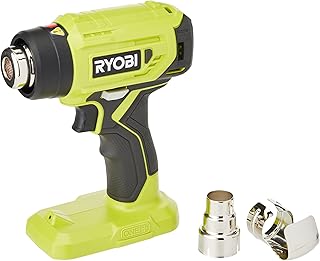

A cordless heat gun can be a particularly useful addition to a DIY toolkit when working without a convenient mains socket. The Ryobi 18V ONE+ R18HG-0 is designed around that idea, combining cordless portability with a maximum temperature of up to 470°C. Ryobi states that the tool reaches its maximum temperature in approximately 60 seconds and supplies two attachments for directing the heat. It is sold as a bare tool, so the battery and charger need to be considered separately if you are not already invested in the ONE+ battery platform.
For buyers comparing cordless heat guns in the UK, however, temperature is only part of the decision. Battery compatibility, runtime, nozzle design, heat control, airflow, ergonomics, intended application and the total cost of ownership can make a greater difference to whether a particular model is genuinely suitable for the job.
These specifications should be treated as the starting point rather than the entire buying decision. A heat gun's practical usefulness depends on how effectively the heat and airflow can be directed at the workpiece and how comfortably the tool can be used for the required duration.
The biggest advantage of a cordless heat gun is freedom from a mains cable. That matters when working outdoors, inside a vehicle, around a workbench where sockets are inconvenient, or in locations where trailing cables could interfere with the job.
A cordless design can also be easier to position around awkward workpieces. This is particularly relevant for automotive work, small repairs and installation tasks where the user may need to move around rather than remain beside a fixed power outlet.
The trade-off is that cordless operation introduces battery management. Runtime depends on the battery capacity, application and operating conditions, so a cordless heat gun should not automatically be assumed to be preferable to a mains-powered model for long, continuous jobs.
One of the strongest reasons to consider the R18HG-0 is its place within the Ryobi 18V ONE+ ecosystem. Ryobi positions ONE+ as a shared battery platform covering a broad range of home, garden, automotive and DIY tools.
This can substantially change the value proposition for an existing Ryobi owner. Someone who already has compatible ONE+ batteries and a charger can purchase the bare heat gun without duplicating those components. Conversely, a buyer starting from scratch needs to account for the cost and practicality of obtaining a suitable battery and charger.
Always check exactly what is included in the listing before comparing prices. The R18HG-0 is a bare tool, meaning that the battery and charger are not supplied with the tool itself.
This distinction is important when comparing a bare Ryobi heat gun with a competitor sold as a complete kit. A lower headline price does not necessarily mean a lower overall cost if you subsequently need to buy a battery and charger.
A maximum temperature of 470°C gives the R18HG-0 sufficient heat for a broad selection of DIY and repair applications, but maximum temperature should not be confused with the ideal operating temperature for every material.
Different jobs require different approaches to heat. Adhesives, plastics, heat-shrink materials, labels and other heat-sensitive components can react very differently to the same temperature. The objective is normally to apply enough heat to achieve the desired result without unnecessarily heating surrounding materials.
For that reason, users should follow the instructions supplied with the material or component being heated. When working with plastics, coatings, electrical components or adhesives, the manufacturer's guidance should take precedence over assumptions based purely on the heat gun's maximum rating.
A heat gun does not simply deliver temperature; it delivers heated air. Airflow affects how quickly heat reaches a workpiece and how broadly that heat is distributed.
The R18HG-0 is specified with an airflow of 170 litres per minute in Ryobi's product documentation. That figure helps explain why nozzle selection matters: the attachment can change how the available heated airflow is concentrated or spread across the working area.
A high temperature combined with a concentrated nozzle can produce a very different result from the same heat gun fitted with a reflector attachment. Buyers should therefore look beyond the headline temperature and consider the complete heating system.
A reducer-style nozzle focuses the heated airflow into a smaller area. This can be useful where heat needs to be applied more precisely rather than across a broad surface.
Typical situations can include heat-shrink work and smaller adhesive-removal tasks, although the correct technique depends on the material and manufacturer's instructions.
A reflector nozzle redirects heat around a component or work area and can be particularly useful for applications where surrounding a section with heated airflow is more appropriate than directing a narrow stream at one point.
The presence of both attachments increases the versatility of the tool. It also reinforces an important buying principle: included accessories should be evaluated according to the jobs they actually enable rather than simply counted as part of a specification list.
A cordless heat gun is a versatile specialist tool rather than a general-purpose replacement for every heating method. The R18HG-0 is marketed for automotive and DIY applications, including removing stickers and adhesives, working with heat-shrink tubing, bending PVC and other tasks requiring hot air.
Portability is especially useful for automotive work. A cordless heat gun can be moved around a vehicle without managing a mains lead, making it convenient for certain repair, finishing and installation tasks.
Potential applications include removing vehicle stickers, working with suitable heat-shrink products and assisting with jobs where a controlled source of hot air is required. Ryobi specifically identifies automotive tasks such as car window tinting and car sticker removal among the intended uses of the R18HG-0.
Care is essential around painted surfaces, trim, wiring, plastics, fuel-related components and other heat-sensitive vehicle parts. The fact that a heat gun can reach 470°C means careless positioning or prolonged heating can damage materials even when the tool itself is operating normally.
Heat-shrink work illustrates why cordless heat guns can be more convenient than improvised heating methods. The heated airflow can be directed towards the tubing while keeping the tool at a controlled distance.
The aim is to shrink the tubing evenly rather than hold intense heat against one point for too long. A concentrator nozzle can help direct the airflow, but the appropriate distance and technique depend on the particular heat-shrink product.
For electrical work, the heat gun should never be treated as a substitute for correct electrical practice. Ensure the circuit is isolated where appropriate and use components that are rated for the intended application.
Heat can soften many common adhesives, making labels, stickers and bonded materials easier to separate. This is one of the more accessible uses for a heat gun, but the underlying surface still matters.
Painted finishes, laminates, plastics, veneers and delicate surfaces can be damaged by excessive heat. Work progressively rather than assuming that the highest temperature will provide the best result.
Battery capacity is an important consideration when choosing a cordless heat gun. Ryobi publishes indicative runtime information for the R18HG-0 based on different ONE+ battery capacities. Its current UK product information gives approximately 7 minutes with a 2.0Ah battery, 9 minutes with a 2.5Ah battery, 14 minutes with a 4.0Ah battery and 18 minutes with a 5.0Ah battery under the stated test conditions.
These figures should not be interpreted as guaranteed real-world continuous operating times for every job. Ryobi explicitly notes that runtime varies according to the tool and application.
For occasional short heating operations, a smaller battery can reduce the overall weight and may be perfectly adequate. For repeated use or longer sessions, a higher-capacity battery may provide a more practical balance between runtime and weight.
If you already own ONE+ batteries, there is little reason to buy another battery solely for the heat gun unless your existing batteries are unsuitable for your working pattern.
Heat guns are often used at relatively close range to the workpiece, so balance and handling can become more important than they initially appear on a specification sheet.
The R18HG-0 is designed as a compact cordless heat gun. Ryobi's published documentation gives a tool weight of approximately 0.6kg without the battery, while battery weight naturally increases the complete working weight.
When comparing models, consider the weight of the complete tool rather than the bare-tool figure alone. A larger battery can improve runtime while also changing the balance and increasing fatigue during prolonged use.
The integrated LED work light is intended to improve visibility around the work surface. It can be useful in darker working areas, inside vehicles and around awkward corners where the user's hands or the tool itself may otherwise cast shadows.
It should be viewed as a convenience feature rather than a substitute for proper task lighting. When using a heat gun, clear visibility is particularly important because the user needs to monitor both the heated material and nearby surfaces.
The best choice depends heavily on how the tool will be used.
The comparison should therefore be based on the entire use case rather than simply asking which tool has the highest temperature.
Ryobi is not the only manufacturer offering battery-powered heating tools. Buyers may also encounter cordless heat guns or related heating products from brands such as Bosch Professional, DeWalt, Makita and Milwaukee.
The most useful comparison is normally between complete battery ecosystems rather than isolated tools. If you already own batteries from one of these manufacturers, compatibility can outweigh relatively small differences in individual tool specifications.
Do not assume that a brand with a larger professional tool range automatically produces the best heat gun for every buyer. The correct choice depends on the required temperature, airflow, control, battery system, accessories, ergonomics and frequency of use.
A useful cordless heat gun comparison should examine more than maximum temperature. The following checklist helps separate genuinely relevant specifications from marketing language.
A 470°C maximum temperature sounds impressive, but maximum heat is not automatically better. Many materials require controlled, moderate heating, and excessive heat can cause damage.
A bare-tool price can look attractive until the cost of a compatible battery and charger is added. Always compare the complete cost of ownership.
A cordless heat gun is convenient until the battery becomes the limiting factor. Consider how frequently the tool will be operated and whether spare batteries are already available.
A higher-capacity battery can increase runtime, but it also adds weight. For short jobs, a compact battery may produce a more comfortable tool.
Nozzles change the way heat reaches the workpiece. Check what is supplied and whether the included attachments suit your intended applications.
Heat-sensitive plastics, coatings, finishes, adhesives and electrical components can react unpredictably. Always consider the material before applying concentrated heat.
A cordless heat gun should be treated as a high-temperature tool even though it does not have a mains cable. Removing the cable reduces one type of hazard but does not make the heated nozzle or airflow safe to touch.
The absence of a power cable should never be interpreted as permission to use the tool in unsuitable conditions. The principal hazard remains the high-temperature airflow and heated nozzle.
Good technique can be more important than buying a more powerful model. Start by identifying the material and the result you are trying to achieve. Then select the appropriate attachment and use the lowest practical heat level or exposure required for the job.
Keep the tool moving where appropriate rather than concentrating heat on a single location. Observe the material continuously and stop as soon as the required result is achieved.
For precision work, a narrower nozzle can help focus the airflow. For broader or wraparound heating, a reflector attachment may be more suitable. The objective is controlled heating, not simply maximum temperature.
When checking current UK listings, compare the exact model number rather than relying on generic descriptions such as “Ryobi cordless heat gun”. The R18HG-0 is a specific model, and listings can differ in whether they include a battery, charger or additional accessories.
It is also sensible to compare specifications against the manufacturer's current information before purchasing. Retailer descriptions can occasionally omit important details, particularly when several kit configurations share similar product names.
For buyers already invested in ONE+, the bare-tool configuration can be particularly relevant. For newcomers, compare the cost of the tool, battery and charger together and then consider whether joining the wider battery platform provides enough value to justify that investment.
Heat guns do not normally require complicated maintenance, but sensible care can help preserve reliable operation. Keep the air intake and surrounding ventilation areas free from accumulated dust and debris, and inspect the tool periodically for visible damage.
Do not obstruct airflow while operating the tool. After use, allow the heat gun to cool safely before storing it. Remove the battery when appropriate for storage and follow the manufacturer's instructions regarding battery care.
Keep nozzles and attachments clean and free from material residue. If a nozzle becomes contaminated with adhesive or another substance, do not attempt to remove it while the component is dangerously hot.
Product specifications can change, and different markets can receive different configurations. Before ordering, verify the exact model number, included accessories, battery status, current manufacturer specifications and applicable UK warranty information.
For the R18HG-0, Ryobi's UK product information identifies the tool as an 18V ONE+ cordless heat gun and confirms that the battery and charger are not included with the bare-tool version. Ryobi also provides product support, manuals and spare-parts information through its support resources.
It can be a strong option for users who value cordless portability and already use the Ryobi 18V ONE+ battery system. Its stated maximum temperature of 470°C, approximately 60-second warm-up time and supplied nozzles make it suitable for a range of DIY and automotive heating tasks. Whether it is the best choice depends on your required runtime, battery ownership, application and need for temperature control.
No. The R18HG-0 is sold as a bare tool, so a compatible 18V ONE+ battery and charger need to be obtained separately if you do not already own them.
Ryobi states that the R18HG-0 reaches up to 470°C and takes approximately 60 seconds to reach that maximum temperature.
Published runtime depends on battery capacity and operating conditions. Ryobi's current UK information gives indicative figures ranging from approximately 7 minutes with a 2.0Ah battery to approximately 18 minutes with a 5.0Ah battery. Actual runtime varies according to application.
Yes. Ryobi specifically identifies car sticker removal and adhesive removal among the intended applications. The correct technique depends on the surface and adhesive, and excessive heat can damage some substrates.
Yes. Heat-shrink tubing is one of the applications identified for the R18HG-0. Use suitable electrical components and follow the tubing manufacturer's instructions for safe and effective installation.
Ryobi identifies bending PVC as one potential application. Not all PVC products behave identically, so the material manufacturer's guidance should be checked before applying heat.
It can provide longer runtime than smaller batteries, but it also adds weight. A 5.0Ah battery is therefore more attractive for longer or repeated tasks, while a smaller battery may be preferable for short jobs where low weight matters more.
Suitability depends on the specific professional application. The tool can be useful for professional tasks where its temperature, airflow, runtime and cordless format meet the job requirements, but users with demanding continuous workloads or specialist heating requirements should compare it with professional-grade alternatives before deciding.
Prioritise maximum and controllable temperature, airflow, warm-up time, battery platform, runtime, weight, nozzle options, ergonomics, included equipment and total purchase cost. Battery compatibility can be particularly important when you already own cordless tools from a particular manufacturer.
The Ryobi R18HG-0 makes the most sense when cordless freedom is genuinely useful and the buyer can take advantage of the 18V ONE+ battery platform. Its 470°C maximum temperature, approximately 60-second warm-up time, 170-litre-per-minute airflow specification, LED work light and supplied nozzles give it a useful specification for general DIY and automotive heating work.
The most important purchasing decision, however, is not simply whether the heat gun reaches 470°C. Consider the jobs you actually perform, how long they take, whether you already own compatible batteries, whether a mains-powered model would be more practical and whether the included accessories provide the control you need.
Before buying, compare the exact R18HG-0 configuration, check what is included, review the latest manufacturer specifications and safety information, and compare the complete cost with other cordless and mains-powered alternatives. That approach is more useful than choosing solely on headline temperature, retailer ratings or the lowest advertised tool price.
For UK buyers comparing cordless heat guns in 2026, the strongest way to assess the Ryobi option is as part of a complete tool ecosystem rather than as an isolated appliance. The R18HG-0 remains relevant where portability, shared batteries and straightforward DIY versatility are more important than specialist heat-control features.
As with any power-tool purchase, specifications and package contents should be checked at the point of purchase because models, kits and retailer listings can change. Independent comparison should focus on the exact model, complete ownership cost and suitability for the intended task rather than relying on a generic “best cordless heat gun” ranking.