

Our experts reviewed the latest {category_name } to help you compare quality, performance, durability and overall value before making your purchase.


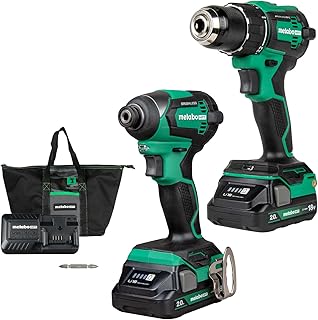


Choosing a Metabo power tool combo kit is less about simply counting the number of tools in the case and more about matching the battery platform, motor technology, tool specification and included accessories to the work you actually expect to do. A two-tool kit can be a better purchase than a larger set if the two machines are used regularly, while a broader kit can make more sense for tradespeople who need several complementary tools without buying each machine separately. Metabo's UK range includes several 18V cordless combo sets with different combinations of drills, impact drivers, angle grinders and other tools. The manufacturer's UK catalogue lists, among others, the Combo Set 2.8.6, Combo Set 2.4.4, Combo Set 2.1.15 and Combo Set 2.8.8, giving buyers several ways to balance capability, battery capacity and overall kit size. The Combo Set 2.8.6 is centred around two of the most useful cordless machines for general construction, installation and renovation work: the SB 18 L combi drill and SSD 18 LT 200 BL impact driver. The UK specification lists two 18V LiPOWER batteries in 2.0Ah and 4.0Ah capacities, an ASC 55 charger and a metaBOX 145 L case. The SB 18 L provides conventional drilling, screwdriving and hammer-drilling capability, while the SSD 18 LT 200 BL is intended for high-torque fastening work. This division of labour is important: a combi drill is generally the more versatile machine for drilling holes and controlled screwdriving, whereas an impact driver is particularly useful when fastening demands greater impact assistance. These figures illustrate why the combi drill remains the general-purpose machine in the pair. Its chuck accepts conventional drill bits, while its hammer function extends its usefulness to masonry. The 200Nm headline figure should not be interpreted as meaning that an impact driver replaces a drill for every job. Its 1/4-inch hexagonal interface and impact mechanism make it particularly suited to fastening, while drilling applications depend heavily on the appropriate hex-shank accessory and material. The Combo Set 2.8.8 is another 18V two-tool combination built around the SB 18 LT BL hammer drill and SSD 18 LT 200 BL impact driver. The manufacturer's catalogue identifies the set with two 5.2Ah LiPOWER battery packs, an ASC 55 charger and a metaBOX 145 L case. The principal distinction from a smaller-battery twin kit is not simply runtime. Larger-capacity batteries can be valuable when the tools are used intensively because they reduce the frequency of battery changes. The trade-off is additional weight, which becomes noticeable when a drill is carried for extended periods or repeatedly used overhead. Brushless technology is one of the most important specifications to examine when comparing professional cordless tools. A brushless motor eliminates conventional carbon brushes and is commonly selected for efficiency, durability and sustained cordless performance. Metabo's own product literature describes its brushless systems as being designed for efficient work progress and demanding applications. However, “brushless” should not automatically determine the purchase. A well-matched brushed or entry-level machine can still be the sensible choice for occasional household work. The more useful question is whether the additional capability will actually be used often enough to justify the extra cost and weight. The Combo Set 2.1.15 18 V BL moves further towards professional-level specification. Metabo lists the SB 18 LTX BL I hammer drill, SSD 18 LTX 200 BL impact driver and two 18V 5.5Ah LiHD battery packs in the set. This is the type of kit worth considering when the priority is not merely having two cordless tools but obtaining a more capable pair for demanding work. The LTX designation and LiHD battery specification place the package in a different part of the range from lighter everyday kits. Metabo's SB 18 LTX BL I family is designed for higher-demand applications, and the manufacturer's broader 18V range includes machines with substantially greater torque and drilling capability than its lighter SB 18 models. Buyers should therefore compare the exact model number rather than assuming that every Metabo 18V combi drill has the same performance. For example, Metabo's SB 18 LTX Impuls specification lists 55Nm soft torque, 110Nm hard torque, 16mm masonry drilling capacity, 13mm steel drilling capacity and 65mm softwood drilling capacity. It also includes an Impuls function, integrated work light and a 13mm chuck. That illustrates an important buying principle: the model family matters. “18V Metabo combi drill” is not a sufficiently precise specification for comparison. Always check the complete model designation and the exact contents of the kit. Metabo's UK combo-set range is not limited to drill-and-impact-driver packages. The manufacturer's UK listing identifies the Combo Set 2.4.4 as including an SB 18 cordless hammer drill and W 18 L 9-125 cordless angle grinder. This type of pairing can be more appropriate for users whose work involves both drilling and metal preparation. An angle grinder opens up a different category of applications from an impact driver, including suitable cutting, grinding and surface-preparation tasks when the correct disc, guard and operating procedure are used. The right combination therefore depends on workflow. A joiner, kitchen installer or general maintenance worker may gain more from a drill-and-impact-driver pair, whereas a fabricator, installer or construction worker may have a stronger reason to prioritise a drill-and-grinder package. One of the most significant considerations when comparing Metabo cordless tools is battery-system compatibility. Metabo states that compatible 18V tools can be combined with 18V battery packs and chargers from brands participating in the CAS battery system. For an existing CAS user, this can change the economics of a combo kit considerably. A buyer who already owns suitable batteries may have little reason to purchase another complete battery-and-charger package, while someone entering the platform for the first time should account for the cost of batteries, charging equipment and future compatible machines. Battery capacity is expressed in ampere-hours, or Ah. In simple terms, a higher Ah rating generally means a larger energy reserve, although actual runtime varies according to the tool, load, material, accessory and operating conditions. Do not automatically choose the highest Ah rating. A compact drill fitted with a large battery may become less comfortable for repetitive overhead or cabinet work. Conversely, a grinder or high-load machine can make a larger battery considerably more attractive. Metabo uses different battery technologies within its cordless range, including LiPOWER and LiHD. The exact advantages depend on the battery generation, tool and application, so buyers should compare the technical specifications of the specific battery rather than treating the branding as a standalone performance guarantee. LiHD packs are particularly relevant when comparing higher-end Metabo kits such as the Combo Set 2.1.15, which is specified with two 5.5Ah LiHD batteries. For occasional DIY work, a lighter battery may be more comfortable and perfectly adequate. For intensive professional use, greater capacity and a battery system designed around higher-demand applications can make more practical sense. Motor construction should be considered alongside torque, speed, weight and price rather than in isolation. A higher torque figure does not necessarily mean a better drill. Maximum torque is only one part of performance. Gear ratios, speed range, chuck quality, electronic control, ergonomics, battery capacity and the intended material all affect how useful a machine is in practice. This is one of the most important distinctions to understand before buying a twin kit. The two tools complement rather than duplicate one another. This is why a good twin kit can be more useful than owning two similar drills. Torque is normally expressed in Newton metres, abbreviated as Nm. It describes rotational force, but a maximum torque figure should not be interpreted as the amount of force the tool will deliver continuously in every application. Manufacturers may publish soft-torque, hard-torque, pulse-torque or maximum figures under defined test conditions. When comparing Metabo models, make sure the figures are genuinely comparable. A 60Nm figure on one model and a 110Nm figure on another may reflect different operating conditions and different machine categories. For an impact driver, maximum torque is similarly only one specification. Bit retention, impact rate, speed, control electronics, ergonomics and the intended fastening application also deserve attention. Drilling capacity is normally stated separately for materials such as wood, steel and masonry. These numbers are more useful for choosing a drill than a single headline torque rating. For example, Metabo's lighter SB 18 Set specification lists maximum drilling diameters of 20mm in softwood, 10mm in steel and 10mm in masonry, alongside 48Nm hard torque. By contrast, Metabo's SB 18 LTX Impuls specification reaches 65mm in softwood and 16mm in masonry, demonstrating why users undertaking heavier drilling should compare the actual model rather than relying on the Metabo name or 18V label alone. A powerful cordless tool can become tiring if it is too heavy or poorly balanced for the intended work. This matters particularly for installers, electricians, joiners and maintenance workers who may operate a drill for extended periods. Check the published weight with and without the battery where available. Metabo's SB 18 Set, for example, is listed at 0.92kg without the battery and 1.3kg with its specified battery. Battery mass can significantly change how a cordless tool feels. A larger battery may improve runtime but can also move the centre of gravity away from the handle. The best configuration is therefore application-dependent. A proper case is more than a cosmetic extra for professional users. It can make it easier to transport the tool, batteries and accessories together while reducing the chance of loose equipment being left behind on site. Several Metabo combo kits are supplied with metaBOX storage, including the Combo Set 2.8.8 and other listed packages. When comparing two similarly specified kits, check the exact case model and internal configuration. “Carry case included” does not necessarily mean that every accessory or spare battery has a dedicated storage position. Before comparing prices, write down the complete contents of each package. A kit that appears cheaper may become less attractive if it contains only one battery or excludes the charger. For example, the officially listed Combo Set 2.1.15 contains two 5.5Ah LiHD batteries with the SB 18 LTX BL I and SSD 18 LTX 200 BL, whereas the Combo Set 2.8.8 is listed with two 5.2Ah LiPOWER batteries and its corresponding tools. Unused tools add cost and storage requirements. Identify the machines you will use every week before considering additional tools. Buying into a new cordless platform means considering future batteries and chargers as well as the initial kit. Existing CAS ownership can materially alter the value calculation. Torque is useful, but it should be considered alongside drilling capacity, speed range, motor type, battery system, weight and control features. High-capacity batteries are not automatically the best choice for lightweight installation work. Smaller packs can make a drill considerably easier to manoeuvre. Metabo uses related model names across different performance levels. Always compare the complete designation, not merely “18V combi drill” or “18V impact driver”. Some tool-only configurations are supplied without batteries and chargers. This can be excellent value for existing users but poor value for someone entering the platform for the first time. DIY users should prioritise versatility, manageable weight and sensible battery capacity rather than buying the most powerful professional specification available. A compact 18V combi drill can cover a surprisingly broad range of household tasks, including assembling furniture, drilling timber, installing shelves and carrying out suitable masonry drilling. Adding an impact driver becomes worthwhile when the user regularly drives longer or heavier fixings. For occasional use, a smaller battery may be preferable because the tool remains easier to handle. If the kit will be used for major renovation projects over several days, additional capacity becomes more attractive. Professional buyers should place greater emphasis on durability, battery interchangeability, ergonomics and downtime. A kit that fits an existing battery ecosystem can reduce the need to maintain multiple chargers and battery families. Frequent users should also consider whether the tools have the required drilling capacity, torque range and control features for their trade. For example, a professional installer may value a compact impact driver and versatile combi drill, while a construction worker may need a higher-output LTX-class machine. Metabo should be compared with other established professional tool manufacturers on the complete system rather than one specification. The best brand is therefore not necessarily the one with the highest individual specification. The stronger long-term choice is often the platform that offers the right combination of tools, batteries, chargers, accessories, ergonomics and future expansion. For a new cordless-tool buyer, a kit containing two batteries and a charger may provide considerably more practical value than a tool-only package. For an existing Metabo or CAS user, however, buying another charger or duplicate batteries may not be desirable. This is why “best value” cannot be determined from the advertised price alone. Calculate the cost of the tools you need, then consider the batteries and charging equipment you already own. Finally, account for the machines you are likely to add over the next few years. Dust and debris should not be allowed to accumulate around ventilation openings, controls or moving components. Follow the manufacturer's instructions for cleaning and servicing rather than using unsuitable methods that could force debris further into the machine. Battery connections should be kept clean and free from contamination. Inspect packs for physical damage before use and follow the manufacturer's storage and charging instructions. Drill bits, driver bits, blades and discs should be selected for the material and machine. A high-powered cordless tool cannot compensate for an unsuitable or damaged accessory. Unusual vibration, excessive heat, abnormal noise, damaged housings or inconsistent operation should be investigated rather than ignored. Where servicing is required, follow the manufacturer's guidance and use an appropriate authorised service route. Cordless operation removes the mains cable but does not remove the hazards associated with drilling, fastening, grinding or cutting. You mainly need drilling, screwdriving and fastening capability and want to keep the overall package manageable. A combi-drill-and-impact-driver combination is one of the most broadly useful cordless pairings. You expect to use the machines intensively and value longer periods between battery changes. Kits such as the 2.8.8 and 2.1.15 illustrate the progression towards larger-capacity batteries and higher-specification machines. Your work involves both drilling and suitable grinding or cutting tasks. The Combo Set 2.4.4 is an example of Metabo pairing an 18V hammer drill with a cordless angle grinder. You already own compatible batteries and chargers and want to expand an established cordless system without purchasing duplicate power packs. Yes, some Metabo combo kits are designed around professional-grade 18V tools, including higher-output LTX-class machines and brushless models. The correct choice depends on the exact tools, battery configuration and workload rather than the kit label alone. For many household drilling, screwdriving and renovation tasks, an 18V kit can provide more than enough capability. The appropriate specification depends on the materials and frequency of use. Compatible Metabo 18V tools can share batteries within the applicable battery system, and Metabo states that its compatible 18V products can work with battery packs and chargers from participating CAS brands. Always verify compatibility for the specific tool, battery and charger before purchasing. A brushless model is generally the more compelling option for frequent or demanding work because of its motor design and efficiency characteristics. For occasional DIY use, however, a less expensive model may provide all the capability required. Not in every situation. A 5.5Ah pack can provide greater energy capacity, but it is also typically a heavier option. A smaller battery may be preferable for lightweight drilling and overhead work. For users who regularly drill holes and drive fixings, the combination is highly practical because each machine is optimised for a different part of the workflow. It can also reduce the need to repeatedly change accessories between drilling and fastening tasks. LTX identifies a higher-performance class within Metabo's cordless range. Exact capabilities vary by model, so the complete product specification should always be checked before making a comparison. No. Torque should be evaluated alongside drilling capacity, speed, control, motor type, weight, chuck design and the intended application. No. Higher-capacity batteries are useful for demanding workloads and longer operating periods, but weight and ergonomics can be just as important for repetitive work. Check the exact tool models, motor type, torque, drilling capacities, battery technology, Ah rating, number of batteries, charger, case, weight and battery-system compatibility. Then compare the complete package against your actual workload. The strongest Metabo power tool combo kit is the one that matches the work rather than the one with the longest specification sheet. For general construction, installation and renovation, a combi drill paired with an impact driver provides a particularly versatile foundation. Buyers with heavier workloads should examine brushless LTX-class machines and higher-capacity batteries, while occasional users can often prioritise lower weight and straightforward functionality. The 2.8.6, 2.8.8, 2.1.15 and 2.4.4 demonstrate how substantially the contents of Metabo kits can differ, even though they share the same broad 18V cordless ecosystem. Before purchasing, compare the complete specifications of the exact kit, confirm battery and charger compatibility, assess the tools you will genuinely use and check current retailer information for the package contents. That approach is more reliable than choosing solely by tool count, advertised torque or headline price.Metabo Power Tool Combo Kits: Buying Guide, Comparison and Expert Advice for 2026
Quick Comparison: What to Look for in a Metabo Combo Kit
Metabo Combo Set 2.8.6: A Practical Two-Tool Combination
SB 18 L Combi Drill Specification
SSD 18 LT 200 BL Impact Driver Specification
Metabo Combo Set 2.8.8: When Brushless Performance Matters More
Why Brushless Motors Are Worth Considering
Metabo Combo Set 2.1.15: A Higher-Specification Twin Kit
What Makes the LTX Combination Different?
Metabo Combo Set 2.4.4 and Other Tool Combinations
Why the 18V CAS Battery Platform Matters
Battery Capacity: 2.0Ah, 4.0Ah, 5.2Ah and 5.5Ah
LiPOWER Versus LiHD: What Should Buyers Know?
Brushless Versus Brushed Metabo Power Tools
Impact Driver Versus Combi Drill
When a Combi Drill Is the Better Choice
When an Impact Driver Is the Better Choice
Torque Ratings: How to Read the Numbers Properly
Drilling Capacity: Do Not Buy on Torque Alone
Ergonomics and Weight: The Specification Buyers Often Overlook
MetaBOX Cases and Storage
What Should Be Included in a Good Metabo Combo Kit?
Common Buying Mistakes to Avoid
Choosing the Largest Kit Simply Because It Has More Tools
Ignoring Battery Compatibility
Comparing Only the Advertised Torque
Buying the Largest Battery for Every Application
Failing to Check the Exact Model Number
Forgetting the Charger
Metabo Combo Kits for DIY Users
Metabo Combo Kits for Tradespeople
Metabo Versus Other Major Power Tool Brands
How to Compare Two Metabo Combo Kits Correctly
How Battery Platform Ownership Changes the Value Calculation
Maintenance and Care for Metabo Cordless Tools
Keep the Tool Clean
Look After the Battery Contacts
Use the Correct Accessories
Do Not Ignore Unusual Behaviour
Safety Considerations When Using Cordless Power Tools
Which Metabo Combo Kit Is Best for You?
Choose a Compact Twin Kit If...
Choose a Higher-Capacity Twin Kit If...
Choose a Drill-and-Grinder Combination If...
Choose a Body-Only Tool If...
Frequently Asked Questions
Are Metabo combo kits suitable for professional use?
Is an 18V Metabo combo kit enough for DIY?
Are Metabo batteries interchangeable between tools?
Is a brushless Metabo drill better?
Is a 5.5Ah battery better than a 2.0Ah battery?
Should I buy a combi drill and impact driver together?
What does LTX mean on Metabo tools?
Does more torque always mean a better drill?
Are larger batteries always better for professional users?
What should I check before buying a Metabo combo kit?
Final Buying Advice
Metabo Combo Kit Buying Checklist