

Our experts reviewed the latest {category_name } to help you compare quality, performance, durability and overall value before making your purchase.




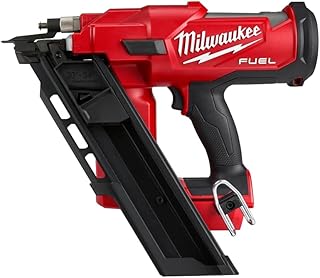


Choosing a Milwaukee cordless nail gun is less about finding the most powerful model and more about matching the nailer to the material, nail size, fixing method and type of work you actually carry out. Milwaukee's UK range includes dedicated finish nailers, a brad nailer, framing nailers and specialist fastening tools, so the differences between models are significant rather than cosmetic. The most important decision is the nail gauge and collation angle. An 18 gauge finish nailer is designed around relatively discreet fixings and a smaller nail hole, whereas a 16 or 15 gauge finish nailer uses a larger, stronger fixing for applications where holding power matters more. Framing nailers sit in another category altogether, using substantially larger framing nails for structural and heavy-duty timber work. One of the biggest practical advantages of choosing an M18 Milwaukee nailer is battery-platform compatibility. Milwaukee states that its M18 system is designed around a common battery platform, allowing compatible M18 batteries to be used across a large range of tools. This can be particularly useful for professional users who already own several M18 products. FUEL models combine Milwaukee's POWERSTATE brushless motor, REDLITHIUM battery technology and REDLINK PLUS electronic intelligence. These technologies are part of Milwaukee's stated M18 FUEL architecture rather than features that should be treated as independent measures of performance. The real buying decision remains the individual nailer's capacity, ergonomics, nail compatibility and intended application. A cordless nailer becomes considerably more convenient when its battery is interchangeable with tools already in your kit. Before buying a bare tool, check whether you already have compatible M18 batteries and a suitable charger. Conversely, a kit containing batteries and a charger may make more sense for someone entering the M18 platform for the first time. Battery capacity also affects the practical balance of a cordless nailer. A larger battery can provide greater runtime, but it can add weight. For repetitive overhead trim work, the lightest sensible battery may be preferable; for high-volume framing or extended site work, additional runtime can be more important. The Milwaukee M18 FN18GS is an 18 gauge straight finish nailer using a 0° nail pitch. It is one of the more relevant choices for users prioritising a neat finish and relatively discreet fixing points. Milwaukee lists features including tool-free depth adjustment, dry-fire lockout, jam-clearing access, an LED work light and interchangeable nose options stored on the tool. Milwaukee also states that the M18 FN18GS can fire up to 1,200 nails per charge when used with a REDLITHIUM 2.0 Ah battery. This should be treated as a manufacturer's stated maximum rather than a guarantee of real-world output, because material, nail length, firing frequency, battery condition and working conditions can all affect runtime. Do not select an 18 gauge nailer simply because it produces a tidy hole. The smaller fixing also means it is not automatically the right choice for heavier trim or joints requiring greater holding power. Check the nail length and material requirements of your specific application first. The M18 FN16GA is a 16 gauge angled finish nailer with a 20° collation angle. Milwaukee describes it as a 2-mode nailer and highlights tool-free depth adjustment, dry-fire lockout, different nose shapes, a compact work-contact bracket and Ready to Fire Nail Technology. Milwaukee's published specifications identify compatible 16 gauge, 20° finish nails in lengths including 32, 38, 45, 50 and 64 mm. The manufacturer's accessories catalogue lists galvanised versions of these nails, so compatibility should always be checked against the exact nail specification rather than assuming that every 16 gauge nail will fit. The angled magazine can be advantageous when working in restricted positions or when approaching a joint from an acute angle. The 16 gauge fixing also occupies a useful middle ground: it is more substantial than an 18 gauge brad or finish nail but remains appropriate for a broad range of second-fix applications. For users regularly fitting skirting boards, architraves, door casings and heavier trim, a 16 gauge finish nailer can therefore be a more versatile choice than an 18 gauge model. However, the correct nail length and substrate remain more important than gauge alone. Milwaukee's M18 FN15GA is a 15 gauge angled finish nailer with a 34° collation angle. Milwaukee's published specifications identify nail lengths from 32 to 64 mm and a 1.8 mm nail diameter for this model. A 15 gauge nail is substantially more substantial than an 18 gauge finish nail. That makes this category worth considering when the joint needs greater mechanical holding power, but it also means the resulting hole is more noticeable. The trade-off is therefore straightforward: choose the smallest suitable nail for the application rather than automatically choosing the largest nailer. The M18 FN16GS is the straight-magazine alternative to Milwaukee's angled 16 gauge finish nailer. Milwaukee specifies 16 gauge straight nails with a 0° pitch, including nails from 25 to 64 mm in its published product information. The straight configuration is important when selecting consumables. A 20° angled nail strip intended for the FN16GA should not be assumed to be suitable for the FN16GS. Nail gauge, length, collation angle and strip configuration all need to match the nailer's specifications. Neither configuration is universally superior. The right choice depends on the nail supply available to you, the spaces in which you work and the type of joints you commonly make. Milwaukee's range also includes the M12 FCN18GS, an 18 gauge straight brad nailer. This should not be confused with the M18 FN18GS simply because both are associated with 18 gauge fastening. The platform is one of the major distinctions. If you already have M12 batteries and commonly perform lighter finishing work, an M12 nailer can be worth considering. If your existing tool collection is predominantly M18, the M18 option may provide a simpler battery ecosystem. This illustrates an important buying principle: the best cordless nail gun is not necessarily the model with the highest nominal capability. Battery compatibility, weight, consumable availability and the actual application can have a greater effect on day-to-day usefulness. The M18 FFN is fundamentally different from the finish nailers above. Milwaukee describes it as a 34° framing nailer with two firing modes, designed to fire standard framing nails suitable for angled magazines at 30° or 34°. Milwaukee states that the M18 FFN can fire up to 700 nails per charge with a REDLITHIUM 5.0 Ah battery. Again, this is a manufacturer-stated figure and should not be interpreted as a guaranteed number of fastenings under every site condition. The FFN is therefore a poor substitute for a dedicated finish nailer when the objective is discreet trim work. Its purpose is larger, heavier-duty timber fastening. Conversely, attempting to use a small finish nailer for structural framing is equally inappropriate. Gauge is one of the most frequently misunderstood specifications when comparing cordless nail guns. In general terms, a lower gauge number corresponds to a thicker nail. Therefore, a 15 gauge nail is larger than a 16 gauge nail, while an 18 gauge nail is smaller. Gauge should never be considered in isolation. Nail length, collation angle, nail-head design, material, substrate and required holding strength all affect whether a particular consumable is appropriate. Buying the correct gauge but the wrong nail length can still result in a poor fastening. A nail that is too short may not provide adequate engagement with the underlying material, while an unnecessarily long nail can create a risk of breakthrough or damage to hidden surfaces. Use the nail length specified for the exact Milwaukee nailer and application. Do not rely on a generic statement such as “16 gauge nails fit 16 gauge nailers”. Collation angle and other physical characteristics matter as well. The angle printed in a nailer's specification refers to the way nails are arranged in the magazine. It is not simply a description of the direction in which the nail enters the timber. Milwaukee's range demonstrates why this specification matters. The FN18GS uses 0° straight 18 gauge nails, the FN16GA uses 20° angled 16 gauge nails and the FN15GA uses 34° angled 15 gauge nails. These are different fastening systems and require their corresponding consumables. Depth adjustment is one of the most useful features on a cordless nailer because different materials and applications can require different seating depths. Milwaukee's finish nailers include tool-free depth adjustment intended to help users drive nails sub-flush. Sub-flush does not mean excessively deep. Driving a finish nail too far can damage the surrounding fibres and leave a larger depression that takes more time to fill. Driving it too shallow can leave the head proud of the surface and interfere with finishing. The correct setting should therefore be established on scrap material or an inconspicuous section before committing to visible work. Material density, nail length, firing behaviour and the desired final finish can all influence the appropriate setting. Some Milwaukee nailers offer more than one firing mode. Sequential firing is generally preferable where precise nail placement is the priority. Bump or contact firing can be useful where speed is more important and the application permits it. For visible trim, sequential operation can make it easier to concentrate on exact positioning. For repetitive construction work, a faster firing mode may improve workflow when used appropriately. Do not treat a second firing mode as an automatic productivity improvement. The correct mode depends on the material, task, required accuracy and safe operating procedure. A dry-fire lockout is a practical feature that prevents the nailer from firing when the magazine has run out of nails. This can reduce unnecessary empty firing and gives the operator a clear indication that it is time to reload. Easy jam access is similarly important for professional users. Even a well-designed nailer can encounter a problematic or incorrectly seated fastener. A tool-free or quick-access clearing mechanism can make an interruption considerably less disruptive. Milwaukee uses Ready to Fire Nail Technology across several of its nailers. The manufacturer's description states that the technology eliminates ramp-up time between nail discharges. The useful takeaway for buyers is not simply the marketing name but the operating characteristic behind it: cordless nailers need to deliver repeatable firing without a noticeable delay between trigger operation and nail discharge. This matters most during repetitive work, where inconsistent firing behaviour can slow progress. Battery-runtime claims are useful for comparison but should not be treated as universal jobsite predictions. Milwaukee publishes figures such as up to 1,200 nails for the M18 FN18GS with a 2.0 Ah battery and up to 700 nails for the M18 FFN with a 5.0 Ah battery. These figures should be considered alongside battery capacity, nail length, material hardness, firing frequency and the condition of the battery. A user driving long nails into dense hardwood is likely to place different demands on a tool from someone installing lightweight trim into softer material. For this reason, “nails per charge” is best used as one comparison point rather than the sole basis for choosing between models. Cordless nailers are often heavier than their pneumatic counterparts because the battery and onboard drive system are integrated into the tool. That difference becomes important when working overhead, on ladders, around cabinetry or across a large installation. When comparing models, consider the complete working weight rather than the bare-tool weight alone. A battery can materially change the balance and handling characteristics. Pay attention to grip shape, trigger reach, magazine position, belt-hook arrangement, contact-bracket design and visibility around the nose. These details can influence productivity more than a small difference in headline specifications. Milwaukee nailers may be sold in different configurations, including bare-tool versions and kits containing batteries, a charger and a storage case. The exact contents vary by model and package. A bare tool is often the logical route for an existing M18 user who already owns suitable batteries and a charger. A complete kit can be more convenient for someone entering the platform, but the value depends on what is included and whether those batteries are useful for other tools in the same system. The purchase price of a nail gun is only part of the long-term cost. Regular users should also consider the price and availability of compatible nails, because a tool that is inexpensive to acquire can become less attractive if its required consumables are inconvenient or costly to source. Milwaukee supplies compatible nail ranges for its fastening tools, including 16 gauge 20° finish nails in several lengths. When comparing alternatives, check equivalent consumable specifications rather than comparing only the tool itself. Nail coating and material should be selected according to the intended environment and the manufacturer's recommendations. A galvanised finish may be appropriate for certain applications, but it should not automatically be assumed to provide suitability for every exterior or corrosive environment. For exposed or demanding applications, check the precise nail specification and the requirements of the project before choosing a consumable. Different woods and sheet materials behave differently under a nailer. Softwoods generally require less driving force than dense hardwoods, while brittle or thin materials may require greater care to avoid splitting or surface damage. Milwaukee specifically promotes the power of its FUEL nailers for consistently seating nails sub-flush in hardwoods. Nevertheless, users should test the selected nail, depth setting and firing mode on representative material before beginning visible work. Hardwood can demand more from the drive mechanism and may expose inadequate depth adjustment more quickly. Test nail seating carefully and ensure that the nail length and gauge are appropriate for the joint. Softwood can be more forgiving, but excessive driving depth can leave unnecessary depressions. A lower-impact setting is not always available, so careful depth adjustment and test firing remain important. Manufactured boards can behave differently from solid timber, particularly near edges. Avoid assuming that a setting suitable for hardwood will produce an equally clean result in MDF or similar sheet material. Milwaukee has a broad fastening range, but brand consistency does not make every nailer suitable for every task. Start with the required nail type and application, then choose the model. Gauge is only one part of the equation. Nail length, material and substrate also affect holding performance. This is one of the easiest mistakes to make when ordering replacement nails. A 16 gauge nail is not automatically compatible with every 16 gauge Milwaukee nailer. More substantial does not mean better for fine work. A large framing nail can be completely inappropriate for delicate trim. A bare tool and a complete kit are not directly equivalent purchases. Always compare what is physically included in each package. If you already own M18 batteries, this can materially alter which configuration represents the better purchase for your circumstances. When comparing several Milwaukee models, use the following order of importance rather than relying on star ratings or headline claims alone. A cordless Milwaukee nailer removes the need for an air compressor, hose and mains-powered compressor setup. This can make moving around a property or jobsite considerably simpler. Pneumatic systems still have their advantages, particularly for users who already have a suitable compressor and require sustained high-volume fastening. The choice is therefore less about one technology being universally superior and more about the working environment. Milwaukee states that its cordless FUEL nailers are designed without gas cartridges and without the routine cleaning associated with gas-powered nailers. That does not mean a nail gun should be neglected. Keep the tool clean, inspect the magazine and nose area, remove debris and follow the manufacturer's operating and maintenance instructions. Do not modify the firing mechanism or use consumables outside the specified range. A cordless nail gun is still a high-energy fastening tool and should be treated accordingly. Read the manufacturer's instructions before use and wear appropriate personal protective equipment for the task and environment. An M18 Milwaukee nailer can make particular sense for tradespeople, contractors, joiners, carpenters and serious DIY users who value cordless mobility and already have access to the M18 battery ecosystem. It can also be attractive to users building a professional cordless tool collection because one battery platform can cover numerous categories. However, buyers should still compare the specific tool against alternatives from brands such as DeWalt, Makita and Bosch Professional rather than assuming that platform loyalty automatically makes one model the best choice. A different cordless platform may be more appropriate if you already own another battery ecosystem and do not want to maintain multiple chargers and battery types. A pneumatic nailer can also remain sensible for workshops with an established compressor installation and high-volume fastening requirements. For occasional DIY users, the economics should be considered carefully. If a nailer will only be used for one small project, hiring may sometimes be more practical than purchasing a professional cordless tool and battery system. Customer ratings can provide useful information, but they should not replace specification checking. A high rating does not necessarily mean that a nailer is appropriate for your application. When reading verified customer reviews, look for comments that identify the exact use case. Reviews mentioning trim work, hardwood, framing, battery performance, jam behaviour and ergonomics are generally more informative than comments that simply describe a product as “powerful” or “good”. It is also worth separating comments about the tool from comments about a particular retailer, delivery experience or packaging. Those factors can be important when purchasing, but they do not necessarily tell you how the nailer performs. There is no single best Milwaukee cordless nail gun for every buyer. The M18 FN18GS is a logical model to investigate when discreet 18 gauge straight finish nails are the priority. The M18 FN16GA is better aligned with users who need 16 gauge angled finish nails, while the M18 FN16GS suits applications requiring 16 gauge straight nails. The M18 FN15GA moves towards heavier finish work, and the M18 FFN belongs in the framing category rather than the finishing category. The best option is therefore the model whose nail specification, platform, ergonomics and working capacity most closely match the job. Choosing by application first will usually produce a better result than choosing by price, battery size or brand popularity alone. The appropriate choice depends on the skirting material, fixing requirements and preferred nail size. A 16 gauge finish nailer can provide a useful balance of holding power and finish, while an 18 gauge model may be preferable where a smaller fixing is appropriate. Check the exact nail length and substrate before deciding. Milwaukee states that its M18 FUEL finish nailers are designed to consistently seat nails sub-flush in hardwoods. However, suitability depends on the particular joint, timber and nail specification. Test the selected consumable and depth setting on representative material first. A 15 gauge nail is larger than an 18 gauge nail and generally offers a more substantial fixing, while an 18 gauge nail produces a smaller, less conspicuous fixing point. The choice should be based on the holding requirement and desired finish. No. Gauge alone does not establish compatibility. Check nail length, collation angle, strip configuration and the exact specification for your Milwaukee model. Neither is universally better. The FN16GA uses 20° angled 16 gauge nails, whereas the FN16GS uses 0° straight 16 gauge nails. Choose according to your application, access requirements and preferred consumables. No. The M18 FFN is a framing nailer. It is designed for framing applications and uses framing nails, making it fundamentally different from Milwaukee's 15, 16 and 18 gauge finish nailers. The M18 FUEL nailers discussed here are battery-powered cordless tools. Milwaukee specifically states that its finish nailers require no gas cartridges. No. The cordless models are designed to operate from their compatible battery systems, so an air compressor and pneumatic hose are not required. Look at your existing battery platform first, then consider the application and desired tool characteristics. Milwaukee offers both M12 and M18 fastening tools, including an M12 18 gauge straight brad nailer and several M18 finish and framing nailers. Professional suitability depends on the model, application and workload. Milwaukee positions its M18 FUEL range towards demanding professional users, but buyers should assess the exact nailer, consumables, battery requirements and working conditions rather than relying on the platform name alone. Follow the manufacturer's instructions for the exact model. Even where a tool is designed to require little routine maintenance, it should still be kept clean, inspected regularly and checked for damage, debris and correct operation. Specifications, package contents, consumable ranges and retailer pricing can change between model revisions and sales channels. Always verify the exact model number and current manufacturer's specification before purchase. Manufacturer-stated runtime figures should be treated as indicative maximum claims rather than guaranteed jobsite performance.How to Choose the Right Milwaukee Cordless Nail Gun
Quick guide to Milwaukee nailer categories
Milwaukee M18 Nail Guns: What the Platform Means
Why battery compatibility matters
Milwaukee M18 FN18GS: 18 Gauge Finish Nailer
Where an 18 gauge finish nailer makes sense
What to consider before buying the FN18GS
Milwaukee M18 FN16GA: 16 Gauge Angled Finish Nailer
Why choose an angled 16 gauge nailer?
Milwaukee 15 Gauge Finish Nailer: When More Holding Power Matters
Typical considerations for 15 gauge applications
Milwaukee M18 FN16GS: Straight 16 Gauge Finish Nailer
FN16GA versus FN16GS
Milwaukee M12 FCN18GS: When a Smaller Platform Makes Sense
Milwaukee M18 FFN: Framing Nailer for Heavy Timber Work
Finish nailer or framing nailer?
Understanding Nail Gauge Before You Buy
Nail Length Is Just as Important as Gauge
Check these specifications before ordering consumables
Collation Angle Explained
Depth Adjustment and Nail Seating
Sequential Fire Versus Bump Fire
Dry-Fire Lockout and Jam Clearing
Ready to Fire Technology: What It Means in Practice
Battery Runtime: How to Interpret Manufacturer Figures
Weight, Balance and Ergonomics
Battery-Only Tool or Complete Kit?
Before choosing a kit, check
Consumables: The Hidden Cost of a Cordless Nailer
Galvanised versus other nail finishes
Materials: Matching the Nailer to the Job
Hardwood
Softwood
MDF and manufactured boards
Common Milwaukee Cordless Nail Gun Buying Mistakes
Buying by brand rather than application
Confusing gauge with nail strength
Ignoring collation angle
Choosing the largest nailer available
Comparing bare-tool prices with kit prices
Ignoring battery ownership
Milwaukee Cordless Nail Gun Comparison Criteria
Milwaukee Versus Pneumatic Nail Guns
Advantages of cordless
Potential disadvantages
Maintenance and Care
Useful routine checks
Safety Considerations When Using a Cordless Nail Gun
Who Should Buy an M18 Milwaukee Nailer?
Who Should Consider an Alternative?
How to Compare Reviews Without Being Misled
What to Check Before Buying Online
Which Milwaukee Cordless Nail Gun Is Best?
Frequently Asked Questions
What is the best Milwaukee cordless nail gun for skirting boards?
Is an 18 gauge Milwaukee nailer suitable for hardwood?
What is the difference between a 15 gauge and 18 gauge nailer?
Can I use any 16 gauge nails in a Milwaukee 16 gauge nailer?
Is the Milwaukee M18 FN16GA better than the FN16GS?
Is the Milwaukee M18 FFN a finish nailer?
Are Milwaukee cordless nail guns gas powered?
Do Milwaukee cordless nailers need an air compressor?
Should I buy an M12 or M18 Milwaukee nailer?
Are cordless nail guns suitable for professional work?
How often should a cordless nail gun be maintained?
Final Buying Checklist
Editorial Note on Product Specifications